Short answer
A single entry door replacement is usually finished in a day, and most door projects run one to two days. The crew protects the floor, removes the old door and its frame, inspects and repairs the framing and subsill, sets the new unit plumb and square with shims, insulates and air-seals the perimeter, finishes the exterior trim and threshold, installs the hardware, adjusts the weatherstripping, cleans up and walks it with you. The one thing that can change the scope is what is found under the threshold once the old unit is out.
A single entry door is usually a one-day job, and most door projects run one to two days. The crew protects your floors, takes out the old door and frame, looks at what is behind it, sets the new unit plumb and square, seals it, trims it, hangs the hardware and walks it with you before leaving.
The reason it is worth knowing the sequence is that two steps in the middle — inspecting the framing and air-sealing the perimeter — are where the quality of the job is decided, and they are the two nobody photographs.
What should you do before the crew arrives?
Not much, and these four things make the day go faster:
- Clear a path. Move furniture, rugs and anything breakable back from the entry, inside and out. The crew needs room to carry a door slab through.
- Clear the outside. Planters, furniture, hoses and door mats away from the opening. Trim anything that has grown into the swing.
- Plan for pets and kids. The door will be open and a doorway will be missing for part of the day.
- Decide where the hardware keys go. If you want the new deadbolt keyed to match your other locks, say so before the day rather than during it.
If you are having the door painted after installation, have the paint on hand or know your plan for it.
What happens, step by step
Confirming the door before anything comes out
The crew checks the unit against the order — size, material, glass, swing direction and hardware — before removing anything. Handing is the item worth confirming yourself. Stand outside looking at the door: an in-swing door with hinges on your right as you face it is a right-hand door. If it is backward, it is far better to find out with the old door still in place.
Protecting the work area
Floor protection inside, drop cloths outside. On a tile or hardwood entry this matters, because a door frame is long and awkward and comes out in pieces.
Removing the old door and frame
The slab comes off the hinges first, then the interior trim, then the frame itself. On a full replacement the brickmold and exterior trim come off too, so the crew can see the rough opening.
Inspecting the opening — the important part
With everything out, the crew looks at the framing, the subsill and the sheathing around the opening. This is where problems live, and entries are where water problems concentrate: no overhang, a threshold that sits low, a stoop that pitches toward the house.
If the framing or subsill is rotted, the honest process is that the crew shows you, explains what the repair involves, and prices it before continuing. A crew that sets a new door onto soft framing has hidden a problem rather than solved it, and the new door will not stay square.
Setting the new unit
The unit goes in, then gets shimmed until it is plumb, level and square, with even reveals around the slab and a threshold that meets the door sweep along its whole length. This is patient work and it is the difference between a door that latches with a fingertip and one you have to lean on. A door that needs a shoulder in January was not set correctly.
Insulating and air-sealing
Low-expansion foam or insulation at the perimeter, then sealing on the exterior side. This is the step you will never see once the trim goes on, and it is the one that decides whether the door performs the way its label says it will.
Flashing, trim and threshold
Exterior trim or brickmold goes back on, the sill pan and flashing detail get completed, and everything gets sealed. Interior casing goes back or gets replaced. On a door replacement the threshold and the sill detail deserve attention, because that is where water arrives.
Hardware and adjustment
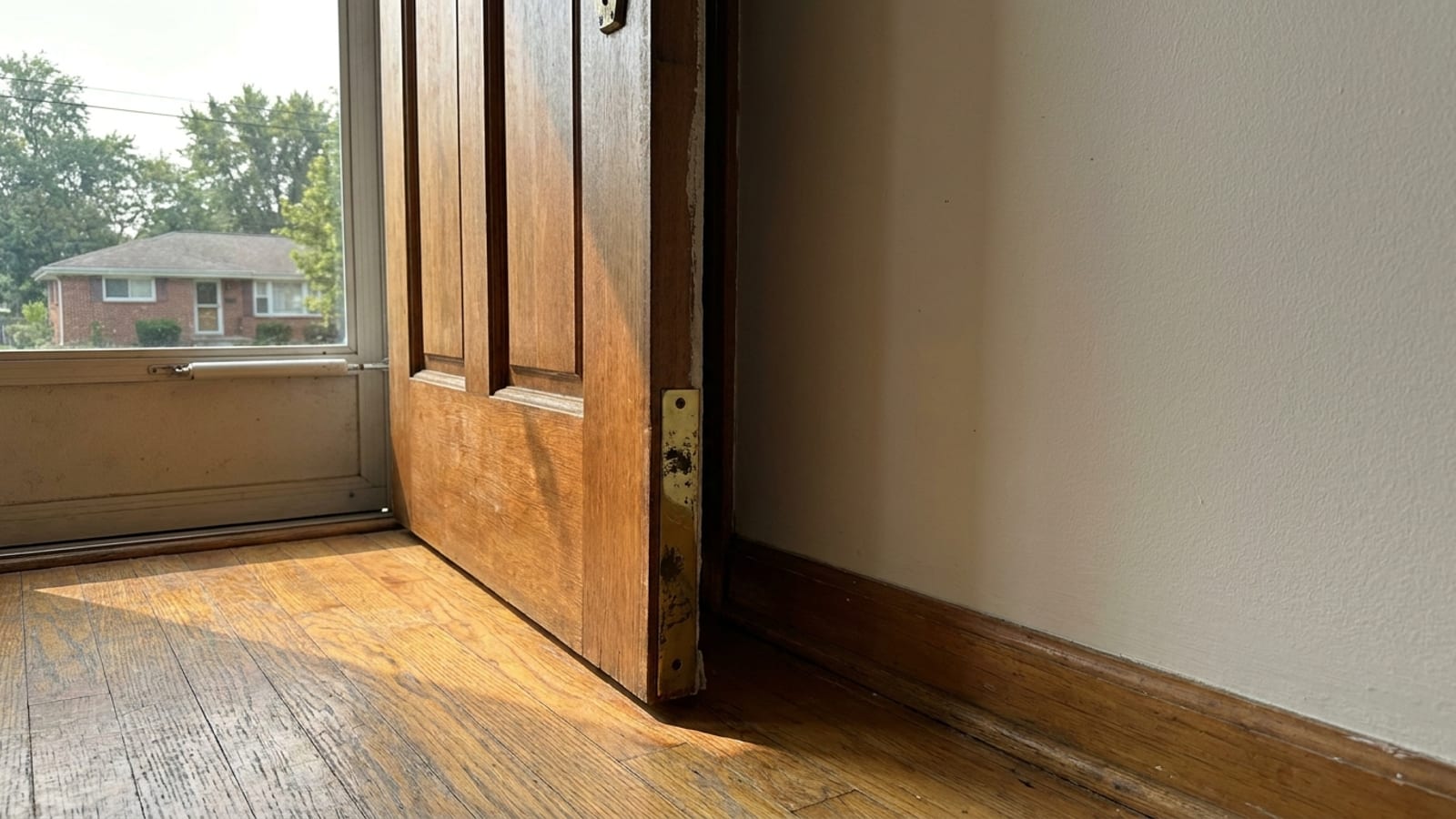
Lockset, deadbolt, strike plate and hinges. A strike plate fastened with long screws into the framing rather than short screws into the jamb is a small detail that does real work for security. Then the weatherstripping and sweep get adjusted so the door closes with even pressure all the way around.
Cleanup and walk-through
The old door, frame and hardware leave with the crew. Then someone walks it with you: open and close it, lock and unlock it, look at the reveals, look at the seal. This is the moment to raise anything, not next week.
How long does each part take?
| Step | Typical time | Notes |
|---|---|---|
| Setup and protection | 20–30 minutes | Longer if access is tight |
| Removing the old unit | 30–60 minutes | Longer on a masonry opening |
| Inspecting the opening | 10–20 minutes | Longer if repair is needed |
| Setting and squaring the new unit | 1–2 hours | The step that should not be rushed |
| Insulating and sealing | 30 minutes | |
| Trim, flashing and threshold | 1–2 hours | Depends on the exterior detail |
| Hardware and adjustment | 30–60 minutes | |
| Cleanup and walk-through | 30 minutes |
A single entry door usually fits in a day. Add sidelights, a transom, a masonry opening, framing repair or multiple doors and it becomes a two-day job. We commit to your dates in a signed timeline agreement rather than a verbal promise.
What should you check at the walk-through?
Six things, and they take three minutes:
- Does it latch with a light push, without lifting or leaning?
- Are the reveals even along the top and both sides?
- Does the deadbolt throw fully without resistance?
- Is there daylight anywhere around the closed door, especially at the bottom corners?
- Does the threshold meet the sweep along its whole width?
- Is the exterior sealed where trim meets siding or brick?
If something is not right, say so while the crew is there. That is what the walk-through is for.
What does it cost, and what is covered?
Exterior door projects with us run $3,973 to $7,500 installed, and that range covers entry, patio, French and storm doors. Removal, disposal, sealing, trim work and cleanup are part of the installed price rather than extras added later.
Larger door and window projects are commonly spread out with GreenSky financing, which includes no-interest options if paid in full within 6, 15 or 18 months and fixed-rate terms, with zero down for most approved homeowners, subject to credit approval.
What we install is covered in writing, material and labor both, under The Patriot's Promise, with $2M insurance on every job.
What is the next step?
The install day goes well when the measurements and the specification were right, and those happen at the estimate. At a free in-home estimate the estimator measures the opening, checks the exposure, the threshold and the existing jamb, confirms the swing, and gives you one itemized price. There is no trip charge inside our service area.
Request a free estimate or call (423) 830-7138.