Short answer
A front door that sticks or will not latch almost always traces to one of four things — seasonal swelling, hinges that have loosened or sagged, a strike plate that no longer lines up with the latch, or a slab and frame that have moved out of square. The first three are usually an afternoon of adjustment with hand tools and cost almost nothing. Replacement is the right call when the slab is warped or rotted, the frame is racked, or you have already shimmed, planed and moved the strike and the door is binding again.
A front door that sticks, drags across the jamb or needs a shoulder to latch is telling you something specific, and in most cases it is not telling you to buy a new door. Four causes account for nearly every sticking entry door we look at: seasonal swelling, loose or sagging hinges, a strike plate that has fallen out of alignment with the latch, and a frame that has moved out of square. Three of those are an afternoon of work with a screwdriver and a chisel. The fourth is the one that turns into a door replacement.
The useful thing is that you can tell them apart in about ten minutes, standing at the door, without taking anything apart.
How do you read a sticking door?
Open the door about a foot and look at the gap between the slab and the jamb all the way around. On a properly hung door that gap is even — roughly the thickness of a nickel along the top and both sides, a bit more at the bottom to clear the threshold and flooring. What you are looking for is where the gap closes up and where it opens wide, because the pattern points straight at the cause.
Tight at the top of the latch side
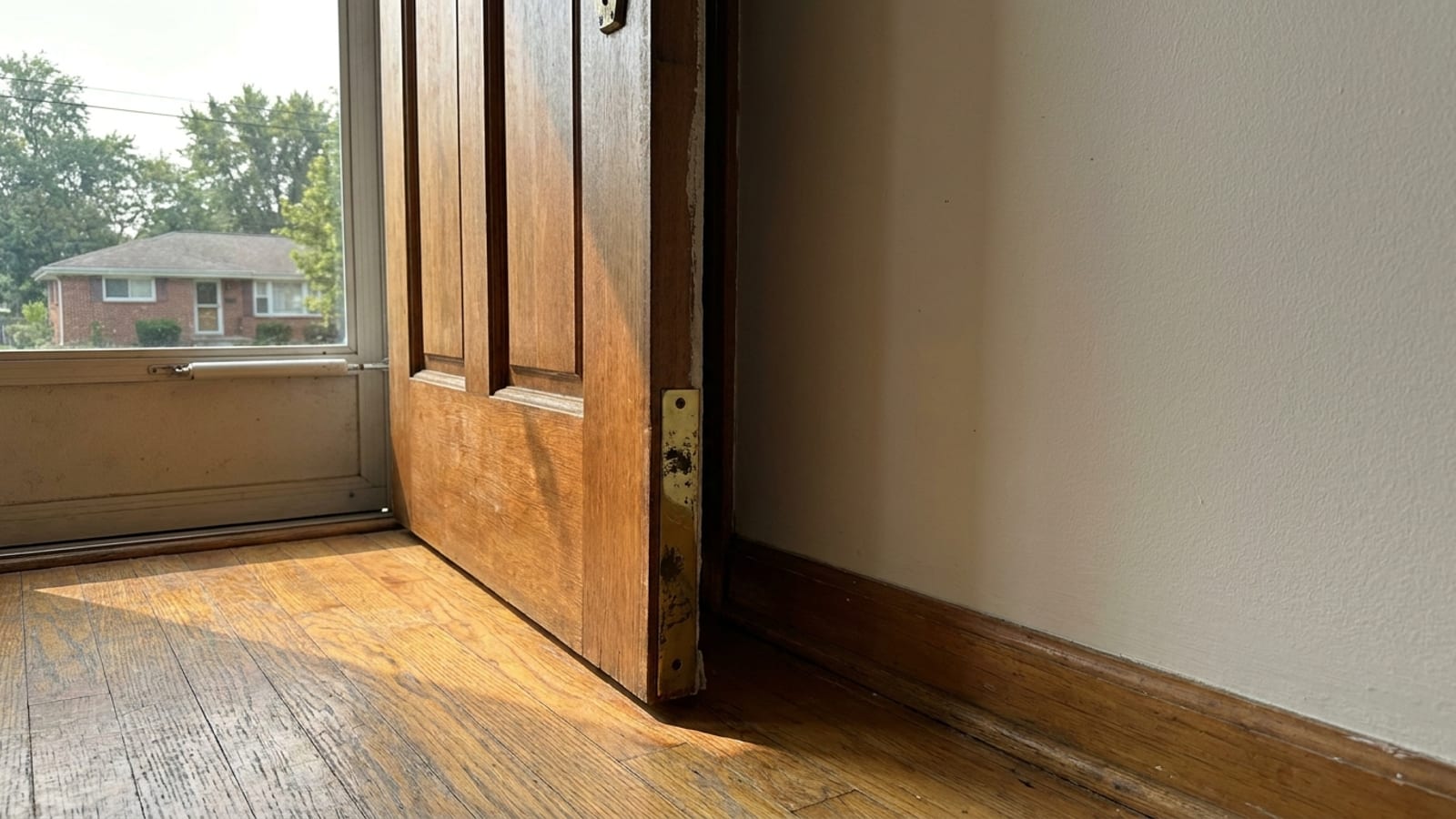
This is the most common pattern in the Southeast and it usually means the top hinge has loosened. Screws back out of the jamb over years of slamming, the slab drops on the hinge side, and the upper outside corner swings down into the frame. You will often see a bright scuff mark on the jamb right where it rubs.
Tight along the whole latch edge, only part of the year
That is moisture. Wood takes on water out of humid summer air and expands across the grain. A wood slab, a wood jamb, or both can grow enough between May and September to eat a 1/8 inch gap and then shrink back by midwinter. If the door swings freely in February and binds in July, you have a swelling problem, not a structural one.
Tight at the bottom, or the door drags on the threshold
Usually an adjustable threshold cranked too high, a sweep that has swollen or come loose, or new flooring installed under the swing. Threshold caps on most modern units adjust up and down on set screws.
The door closes but will not latch
The slab is fine; the hardware is out of alignment. The latch bolt is hitting the strike plate above, below or outside the hole. Lipstick or a carpenter's pencil smeared on the end of the latch bolt will leave a mark on the strike that shows you exactly which way it has drifted.
The gap is wedge-shaped from top to bottom
Wide at one corner, pinched at the diagonal corner. That is a racked frame, and it means the opening itself is no longer square. This is the pattern that most often ends in replacement rather than adjustment.
What is the likely fix for each symptom?
| What you see | Likely cause | Typical fix | Repair or replace |
|---|---|---|---|
| Rubs at top of latch side | Loose or worn top hinge | Longer screws into the framing, or shim the hinge | Repair |
| Binds only in humid months | Wood swelling | Relieve and seal the edge, paint all six sides | Repair |
| Latch misses the strike | Strike plate drifted | Move or file the strike, adjust hinges | Repair |
| Drags on the sill | Threshold set too high, swollen sweep | Lower the threshold screws, replace the sweep | Repair |
| Daylight at one corner, tight at the opposite | Frame racked out of square | Reset or rebuild the unit | Usually replace |
| Soft wood at the sill or bottom rail | Water intrusion and rot | Full unit replacement | Replace |
| Steel slab bowed, or fiberglass skin delaminating | Slab failure | Full unit replacement | Replace |
Which repairs are worth trying first?
Start with the cheapest fix that matches the symptom. In order:
- Tighten the hinges. Remove one screw at a time from the jamb-side hinge leaves and replace them with 3-inch screws that reach past the jamb into the framing behind it. On a sagging door this alone fixes the problem more often than anything else on the list, and it costs about four dollars.
- Check the strike plate. If the latch is hitting high or low, you can often file the strike opening a sixteenth of an inch and be done. If it is off by more than that, remove the plate, move it, and fill the old screw holes with glued dowel or toothpicks so the new screws bite.
- Adjust the threshold. Most adjustable thresholds have four to six set screws under the cap. Back them off a quarter turn at a time until the door clears but the sweep still touches.
- Relieve a swollen edge. On a wood door only, take a small amount off the binding edge with a block plane, then prime and paint the bare wood immediately. An unsealed edge drinks moisture and the problem returns next summer.
- Lubricate. Dry hinge pins and a dry latch make a door feel like it is binding when it is not. A shot of dry lubricant on the pins and the latch bolt is a thirty-second test worth doing before anything else.
When does a sticking door actually mean replacement?
The dividing line is the same one that applies to windows. Repair the parts; replace the door.
Replace when the frame is racked and will not square up, because every adjustment you make to the slab is compensating for an opening that is wrong. Replace when there is soft, spongy wood at the bottom of the jamb or at the sill — that is rot, it is structural, and a new slab in a rotted frame fails the same way. Replace when a steel door has bowed, when a fiberglass skin is separating from the stiles, or when a wood slab has warped enough that one corner sits proud of the stop with the latch engaged. And replace when you have already done the hinges, the strike and the threshold, the door closed fine for a season, and now it is binding again.
One more honest trigger: if you are replacing hardware and weatherstripping on a thirty-year-old builder-grade door that was never insulated well to begin with, you are spending money to improve something that will still be the weakest part of the wall when you are finished.
What does replacing the front door cost?
A replacement entry door installed runs about $3,973 to $7,500 in our market. That is a complete number — the slab, the frame, the hardware, the labor and the finish work — not a door price with install added later. Where a project lands in that range comes down to material, glass, whether you add sidelites or a transom, and what condition the opening and the subsill are in once the old unit comes out.
Material is usually the first decision. Steel is the value choice, strong and well insulated, and it is the right pick for a door that sits under real cover. Fiberglass costs more and does not dent, rot or rust, which makes it the better answer on an entry that takes direct afternoon sun or driving rain. We are manufacturer-direct on ProVia and Andersen in both materials.
Most entry door installs are finished in one to two days. The work covered under The Patriot's Promise carries a 15-year material and labor warranty on entry doors, and the labor term is the line worth comparing when you have two quotes in front of you. If the number is the obstacle rather than the decision, financing through the GreenSky program includes no-interest-if-paid-in-full plans at 6, 15 or 18 months and fixed rates starting at 6.99% APR, with zero down for most approved homeowners.
One more thing worth knowing before you price anything: active military, veterans, police, fire, EMS and dispatchers get 50% off exterior doors through our Hometown Hero program. It applies to the door itself, it does not stack with other offers, and proof of service or a department ID at the estimate is all it takes.
What should you do next?
Work the cheap fixes first. Tighten the hinges with long screws, check the strike with a pencil mark, adjust the threshold, and see where you stand after an afternoon. If the door swings and latches cleanly, you are done and you spent almost nothing.
If the gap is wedge-shaped, the sill is soft, or you have already been through the adjustments once, the fix is a new unit set plumb and square in a repaired opening. Schedule a free in-home estimate and an estimator will measure the opening, look at the frame and threshold condition, show you the steel and fiberglass options, and give you one itemized price with the install method spelled out. It is a sales appointment, and it is also the only way anyone can give you a real number instead of a guess.