Short answer
The four numbers on a window's NFRC label are U-factor (heat flow), SHGC (solar heat gain), visible transmittance (light) and air leakage (drafts). In the Southeast, SHGC is the number that matters most because our biggest energy cost is keeping summer sun out, not holding furnace heat in. A good window for this region pairs a low SHGC with a solid U-factor rather than chasing the lowest U-factor on the shelf.
Every replacement window you're quoted carries four numbers, and most homeowners never get them explained. Here's what each one means, and which ones actually matter in a climate where the air conditioner runs from April to October.
Where do these numbers come from?
They come from the NFRC label — the sticker on the glass of a new window. NFRC is an independent body that tests whole window assemblies under standardized conditions so that one manufacturer's number can be compared directly against another's. It's the closest thing the industry has to a nutrition label.
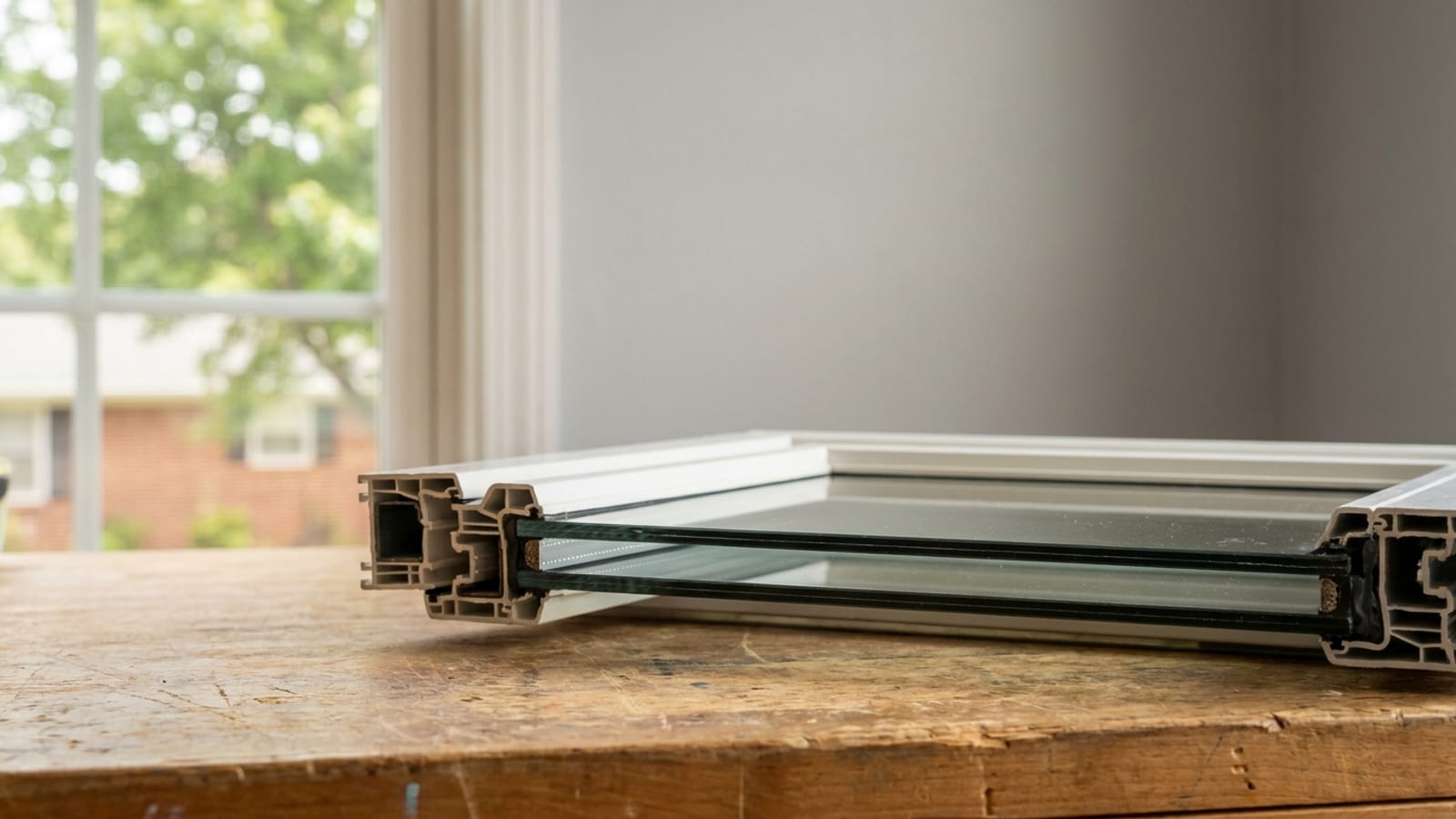
Two things make it trustworthy. First, it rates the whole unit — glass, frame, spacer and sash together — not just the best-performing patch in the middle of the glass. Second, every manufacturer tests the same way, so a 0.28 from one brand means the same as a 0.28 from another.
That matters when you're holding three quotes. Product names, series numbers and marketing terms are not comparable across companies. NFRC numbers are. When we price replacement windows, those numbers are on the itemized quote so you can lay them side by side with anyone else's.
What is U-factor, and does it matter here?
U-factor measures how fast heat moves through the window. Lower is better. Typical residential range is about 0.15 to 0.60.
It's essentially the opposite of an R-value. If you know insulation, think of U-factor as R-value flipped upside down — a U-factor of 0.25 is roughly an R-4 window.
U-factor is the number that dominates in Minnesota, where the job of a window is holding furnace heat inside on a 10-degree night. In the Tennessee Valley and North Georgia we do have real winter, so it isn't irrelevant. But our heating season is short and our cooling season is long, which is why U-factor is the second number to look at here, not the first.
Where U-factor does earn its keep locally: it drives how cold the interior glass surface gets, which drives condensation and that clammy feeling standing next to a window in January.
Why is SHGC the number that matters most in the Southeast?
SHGC — Solar Heat Gain Coefficient — measures how much of the sun's heat gets through the window. It's a decimal between 0 and 1. A SHGC of 0.25 means 25% of the solar energy hitting that window ends up as heat in your house.
Lower is better in a cooling climate, and our climate is emphatically a cooling climate.
This is the number behind the complaint we hear most: the west-facing room nobody can use after 3 p.m., the sunroom that's ten degrees warmer than the rest of the house, the kitchen that stays hot until dark. That's not a U-factor problem. That's solar gain pouring through glass, and the fix is a Low-E coating engineered to reflect infrared.
If you take one thing from this article: in Tennessee, Georgia and Alabama, ask about SHGC first. A salesperson who only talks about U-factor is selling you a Northern spec.
What is visible transmittance?
VT measures how much visible light passes through, also 0 to 1. Higher means brighter.
The fear people have is that blocking heat means blocking light — that a high-performance window will make the living room feel like a parking garage. Modern Low-E coatings are spectrally selective, meaning they're tuned to reject the infrared part of sunlight while letting visible light through. So you can get a low SHGC and a VT that still reads as bright and normal to the eye.
VT also drops as you add glass layers and grids. If a room is already dim, mention it at the estimate and we'll weigh the glass package accordingly.
What is air leakage, and why is it often ignored?
AL measures how much air passes through the assembly, in cubic feet per minute per square foot. Lower is better, and anything at or below 0.30 is considered tight — that's the ceiling most quality units are built to hit.
Air leakage gets ignored because the differences between decent products look small on paper. But it's the rating that most closely matches what you feel. A draft is air movement, not heat conduction. It's also the rating most affected by window style: casements pull a sash against a compression seal when you crank them shut, which is why they typically test tighter than a double-hung, where two sashes slide past weatherstripping.
What do good numbers look like for our region?
Most of our service area — Chattanooga, Cleveland, Dalton, Rome, metro Atlanta, Fort Payne — falls in ENERGY STAR's South-Central climate zone. Here's how to read a label for a house here.
| Rating | What it measures | Good for our climate | Why |
|---|---|---|---|
| SHGC | Solar heat let in | 0.25 or lower | Cooling load is the main energy cost here |
| U-factor | Heat conducted through | 0.30 or lower | Short heating season, but it drives winter comfort |
| Visible transmittance | Daylight let in | 0.40 or higher | Keeps rooms bright despite a low SHGC |
| Air leakage | Drafts through the assembly | 0.30 or lower | The number you actually feel |
| Condensation resistance | Resistance to interior fogging | Higher is better | Optional rating; useful in humid rooms |
ENERGY STAR publishes its own thresholds by zone and updates them periodically, so treat the table as the practical target rather than the certification text. The current South-Central criteria sit in the neighborhood of a 0.28 U-factor and a 0.23 SHGC — verify against the version in force when you buy.
The tradeoff nobody mentions
U-factor and SHGC don't move independently. Glass packages built to drive U-factor down toward Northern numbers often allow a higher SHGC, because holding in furnace heat and letting in free solar heat is exactly what a Northern window is supposed to do. Chasing the lowest U-factor on the shelf can hand you a window that's worse for a July afternoon in Hixson.
The right window for this region is a balanced pair: strong SHGC control with a competent U-factor behind it.
Do the right numbers change room by room?
Somewhat, and it's worth a conversation rather than a blanket spec.
- West and south exposures take the most afternoon sun. This is where a low SHGC pays off hardest.
- North exposures get little direct sun, so SHGC matters less and U-factor carries more weight.
- Heavily shaded elevations — mature oaks, a deep porch, a neighbor's roofline — already have their solar gain cut. You may prefer a higher VT there for daylight.
- Bathrooms and kitchens generate humidity, so condensation resistance is worth asking about.
Most homeowners run one glass package house-wide for simplicity and cost. That's a perfectly good decision. But if there's one room that's unbearable in summer, say so — the label numbers give us something concrete to fix it with.
What actually changes these numbers on a quote?
Four things, roughly in order of impact:
- The Low-E coating. Which coating, and how many surfaces it's applied to. This is the single biggest lever on SHGC.
- Gas fill. Argon between the panes conducts heat more slowly than air. Standard on the insulated glass we quote.
- The spacer. The strip separating the panes at the edge. Warm-edge spacers cut the thermal bridge at the perimeter and improve both U-factor and condensation resistance.
- The frame and number of panes. Frame material and chamber design move U-factor; a third pane moves it further, at real cost and weight.
Our Patriot 3000 and Patriot 7400 series are built with ENERGY STAR certified, Low-E, argon-filled insulated glass, and we're manufacturer-direct on Andersen, MI, Polaris, Vinyl Max, Windsor, Sunrise and HGI — so the glass package gets matched to your exposures rather than to whatever one line we happen to stock.
Do better ratings pay for themselves?
It depends entirely on what's coming out. ENERGY STAR estimates that replacing old single-pane windows with certified units saves around 12% on energy bills on average. Going from serviceable 15-year-old double-pane to a new high-performance package saves less in dollars, though the comfort difference on a west wall is immediate and obvious.
Be skeptical of anyone who quotes you a specific percentage for your house. Nobody can know it without knowing your existing windows, your exposures, your shade and your thermostat habits.
If the better glass package is what's stretching the budget, financing is usually the better lever than downgrading the spec — zero down for most approved homeowners, with no-interest options if paid in full within 6, 15 or 18 months.
What should I ask at the estimate?
Bring these four questions and you'll learn more than any brochure will tell you:
- What's the whole-unit SHGC and U-factor on the product you're quoting — not center-of-glass?
- Is this glass package specified for the South-Central zone, or is it the manufacturer's national default?
- What spacer is in it?
- Is the air leakage rating on the quote?
A label number only describes the unit. It becomes real performance when the opening around it is sealed, insulated and flashed correctly — which is why both the product and the labor are covered under The Patriot's Promise, with a lifetime material and labor warranty on windows, transferable once.
Next step
We'll measure your openings, look at which walls take the afternoon sun, and put the actual ratings on the quote next to the price so you can compare it honestly against anything else you're holding.
Get a free estimate, or call (423) 830-7138 and we'll talk through the glass options for your exposures.