Short answer
Double-hung is the better default for most homes in Tennessee, Georgia and Alabama because it suits almost every house style here and both sashes tilt in for cleaning. A horizontal slider is the better unit on a wide, short opening, above a counter or a tub deck, and anywhere an easy one-hand slide matters more than the traditional look. Match the style to the shape of the opening and how the room gets used, not to a single rule for the whole house.
A horizontal slider and a double-hung do the same job in two different directions, and the opening usually picks the winner before you do. Double-hung is the better default for most homes across Tennessee, Georgia and Alabama because it fits nearly every house style in this market and both sashes tilt in for cleaning. A slider earns the wide, short openings, the hard-to-reach ones over a counter or a tub, and any spot where a one-hand push beats lifting a sash.
This is a style decision, not a quality decision. Both are legitimate replacement window styles, both are built in the same product lines, and both land inside the same installed price range. What changes is how the window behaves in the room every day.
What is the actual difference between the two styles?
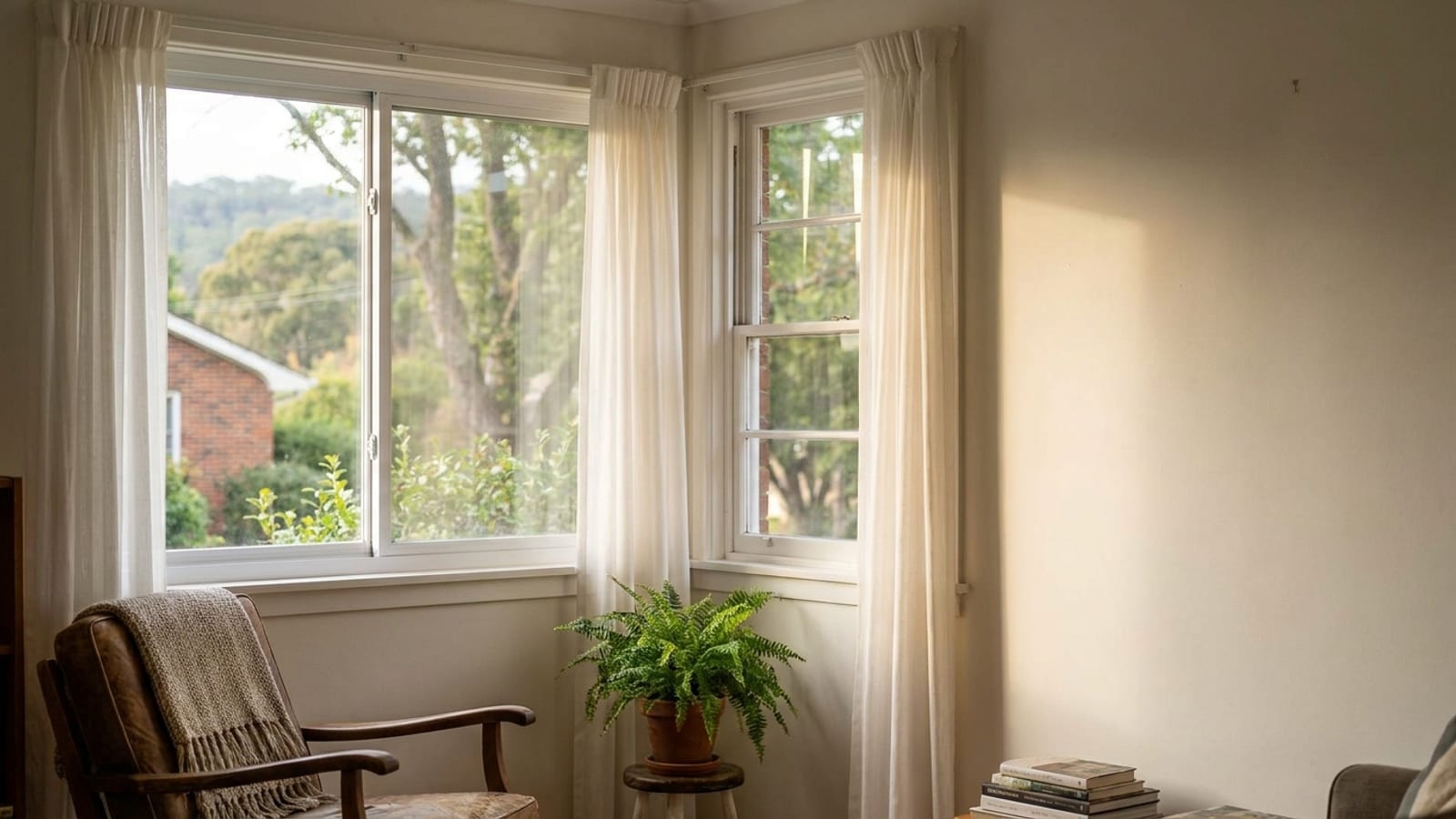
A double-hung has two sashes stacked vertically in a single frame. Both move up and down, both tilt inward for cleaning, and the screen sits on the exterior for the full year. You can open the bottom, the top, or both at once, which is the one trick no slider can do.
A horizontal slider has one or more sashes that glide side to side on a track at the head and sill. A two-panel slider has one operating sash and one fixed panel. A three-panel slider typically has a fixed center with operating sashes on both ends. The screen is on the exterior here too, covering whichever half the operating sash leaves open.
That single structural difference drives everything else. Vertical movement means a sash has to be held up by a balance system and lifted against gravity. Horizontal movement means the sash rides on rollers and gravity is out of the equation, which is why a slider usually takes less effort to open and why a wide slider sash is more practical than a wide double-hung sash of the same size.
Why opening shape matters more than preference
Double-hungs look right when the opening is taller than it is wide. That is the proportion most windows in this market were built to. Sliders look right when the opening is wider than it is tall, which is exactly the shape you find in basements, over kitchen counters, above tub decks and in many 1970s-through-1990s ranch elevations. Forcing a tall double-hung into a wide, short hole produces a squat window that reads wrong from the street, and stretching a slider across a tall opening looks equally off.
Which window moves more air?
Both top out at about half the opening, but they get there differently.
A double-hung with the top and bottom sashes both open creates a convection path within a single window. Warm air near the ceiling exits across the top, cooler air comes in across the bottom. On a mild evening that is a genuinely useful way to flush a room without a fan.
A slider gives you one clear half of the opening with nothing dividing it, which is simpler and feels more open. If the opening is wide, that half can be a very large gap. A three-panel slider with both ends open delivers airflow at two separate points across a long wall.
Neither matches a casement, which swings out and scoops air. That comparison is a different conversation, and we covered it separately. Between these two, the practical answer is that a double-hung ventilates more cleverly and a slider ventilates more simply.
How do they compare on cleaning, screens and daily use?
| Factor | Double-hung | Horizontal slider |
|---|---|---|
| Typical opening shape | Taller than wide | Wider than tall |
| Maximum vent area | About half, top or bottom or split | About half, one side |
| Cleaning the exterior glass | Both sashes tilt in from inside | Sash lifts out or needs outside access |
| Operating effort | Lift against a balance system | Slide on rollers, little effort |
| Moving parts to maintain | Balances, tilt latches, locks | Rollers, track, locks |
| Screen location | Exterior, full year | Exterior, covers the operating half |
| Best fit | Street-facing elevations, bedrooms, upstairs | Basements, over counters, baths, wide walls |
| Installed cost range | $700 to $2,200 per window | $700 to $2,200 per window |
Cleaning is the clearest split. A second-floor double-hung can be washed inside and out without leaving the room, and on a two-story house that convenience adds up every spring. A slider usually means lifting the sash out of the track or reaching the exterior face from outside.
The track is the slider's maintenance item. Dirt, pollen and grit collect in the bottom channel, and that is what makes an older slider drag. A vacuum pass and a wipe a couple of times a year keeps it gliding. Double-hungs do not collect grit the same way, but their balance systems are what eventually wear and need service.
Does one style seal better than the other?
Both are sliding-sash designs, so both seal with weatherstripping that the sash slides past rather than a sash that compresses shut like a casement. In practice their air leakage ratings land in the same neighborhood, and the difference between two quoted windows is almost always the product line and the glass, not the style name.
That is where the numbers that matter live. Our entire service area sits in the ENERGY STAR South-Central climate zone, where a qualifying window needs a U-factor of 0.28 or lower and an SHGC of 0.23 or lower. In this climate SHGC is the number doing the heavy lifting, because keeping summer sun out of the house costs more than holding heat in during the winter. We spec glass by elevation for that reason, and a slider on a west wall and a double-hung on a north wall should not necessarily carry the same coating.
Installation decides more than most homeowners expect. A window set plumb, square and air-sealed to the rough opening performs the way its label says. One shimmed carelessly does not, whatever style it is. Every unit we install is covered under The Patriot's Promise, which carries a lifetime material and labor warranty on windows, transferable once and prorated after that.
Where does each style actually belong in a house?
A practical breakdown for homes in this region:
- Bedrooms. Double-hung, usually. The egress requirement favors a tall opening with a full-width sash, and the tilt-in cleaning matters on upper floors.
- Kitchens over a counter or sink. Slider, often. Reaching across a deep counter to lift a sash is awkward, while a slide takes one hand. Casement is the other strong answer here.
- Basements. Slider, in most cases, because the openings are wide and short by nature.
- Bathrooms over a tub. Slider. Same reach problem as the kitchen, with water involved.
- Street-facing elevations. Double-hung, for most house styles here. Colonials, traditional two-stories, bungalows and farmhouses all read correctly with vertical sashes.
- Long rear walls and sunrooms. Three-panel sliders pair well with a patio door and keep the sight lines horizontal.
Mixing styles is normal and we do it on most whole-house projects. What keeps a mix from looking accidental is consistency in the things the eye actually tracks from the curb — frame color, grid pattern and glass tint.
What do they cost, and does the style change the price?
Replacement windows in our market run about $700 to $2,200 per window installed, and that figure covers the unit, the labor, the sealing, the trim and the cleanup. Style is a minor factor inside that range compared with size, frame material, glass package and whether the opening takes an insert or needs full-frame replacement.
Where style does move money is at the extremes. A very wide three-panel slider is a large piece of glass and hardware, so it prices toward the top. A standard-size double-hung in a sound frame is the most common unit we install and sits lower in the range. If a whole-house number is the obstacle rather than the per-window number, financing through the GreenSky program includes no-interest-if-paid-in-full plans and fixed-rate terms, with zero down for most approved homeowners.
What is the next step?
Walk your house and sort the openings by shape before you think about style names. Anything clearly taller than it is wide is a double-hung candidate. Anything wider than it is tall, or anything you have to reach across to operate, is a slider candidate. Then have someone measure and confirm, because egress, sill height and frame condition can override the obvious answer on a given opening.
Schedule a free in-home estimate and we will measure every opening, recommend a style for each one, spec the glass by elevation and give you one itemized price per window. It is a sales appointment, and it is also the only way to get a real number instead of a guess.