Short answer
Replacing windows in an older home is a different job than replacing them in a 1990s subdivision house, because the openings are rarely square, the old weight-and-pulley pockets are open cavities in the wall, and any home built before 1978 is presumed to have lead paint that has to be handled under EPA Lead-Safe rules. Full-frame replacement is the right call more often on old houses than on newer ones. The window itself is the easy part; the framing, the pocket and the exterior trim detail are what make the job.
Replacing windows in an older home is a different job than replacing them in a 1990s subdivision house. The openings are rarely square, there is usually an open weight pocket hidden on each side of every window, the exterior trim is part of the architecture rather than a wrap around the frame, and anything built before 1978 has to be treated as a lead-paint job.
None of that makes an old house a bad candidate. It makes it a job where the measure and the tear-out matter as much as the product. Here is what actually changes.
Why are old window openings never square?
Houses move. A hundred years of settling, seasonal soil movement, foundation work, roof loads and a few generations of repairs leave openings that are out of square, out of plumb, or bowed in the middle. It is normal to find openings on the same wall of the same house that differ by half an inch or more.
That matters for two reasons. First, every replacement window has to be built to its own opening, which is why a real final measure on an old house takes longer than on a newer one. Second, an opening that is meaningfully out of square cannot simply have a rectangular unit shoved into it. The unit has to be set plumb, level and square in a hole that is none of those things, and the difference gets taken up in shimming and in the trim detail.
When an installer skips that and forces a window to follow the old opening instead of correcting it, you get the classic result: a sash that binds at one corner, a lock that will not engage cleanly, and a reveal that visibly tapers from one side to the other.
What is a weight-and-pulley sash pocket, and why does it matter?
Open an original double-hung in an old house and you will often find a rope or chain disappearing into a small pulley at the top of the jamb. On the other end, inside the wall, hangs a cast iron weight. That weight is what held the sash up before spring balances existed.
The weight needs room to travel, so there is a hollow cavity running the full height of the window on both sides. In most houses that cavity has no insulation in it at all. It is an uninsulated shaft in your exterior wall, next to the framing, on every original window in the house.
That is why old houses can feel drafty around windows even when the sashes themselves are in decent shape. It is also why an insert window that drops into the old frame and leaves the pocket untouched is a missed opportunity on this kind of house. Doing it right means pulling the weights, removing the pulleys, insulating the cavity and sealing it before the new unit goes in.
Should an older home get insert or full-frame replacement?
Full-frame is the right call more often on old houses than on newer ones, though plenty of homes correctly get a mix.
An insert replacement drops a new window into the existing frame. That is a good answer when the frame is sound, square enough and dry. A full-frame replacement takes everything out to the rough opening and rebuilds it, which is what you want when the sill is soft, the frame is out of square, there is a water intrusion history, or you want the weight pockets opened up and insulated.
| Situation on an older home | Usual approach | Why |
|---|---|---|
| Sound frames, no rot, openings close to square | Insert | Faster, less trim disturbance, lower cost |
| Soft or rotted sill or jamb | Full-frame | You cannot build on rot |
| Open weight-and-pulley pockets you want sealed | Full-frame | Access to insulate the cavity |
| Opening noticeably out of square | Full-frame | Rough opening can be corrected |
| Old aluminum storm-and-sash combination | Full-frame | Recovers glass area lost to the old frame |
| Water staining below the window inside | Full-frame | The flashing detail gets rebuilt |
Full-frame typically adds several hundred dollars per opening. On an old house that premium usually buys something real: a corrected opening, an insulated pocket, and new flashing where the old detail failed.
What do the lead-safe rules mean for a pre-1978 house?
Lead paint was in general residential use until it was banned for that purpose in 1978. Any home built before then is presumed to contain it, and window openings are one of the worst places for it, because painted sashes rub against painted jambs and grind paint into dust every time the window is opened.
Patriots' Pride is Lead Safe Certified and EPA Accredited, which is not a marketing line, it is the credential that governs how the work area is set up. In practice, on a pre-1978 home that means containment around the work area, controlled removal instead of dry sanding or open-flame methods, HEPA cleanup, and debris handled rather than swept into the yard.
Ask any company you are considering whether they are lead-safe certified for pre-1978 work. It is a fair question and the answer should be immediate.
How do you keep the house looking like itself?
This is the part homeowners with older houses care about most, and it is mostly decided before anything is ordered.
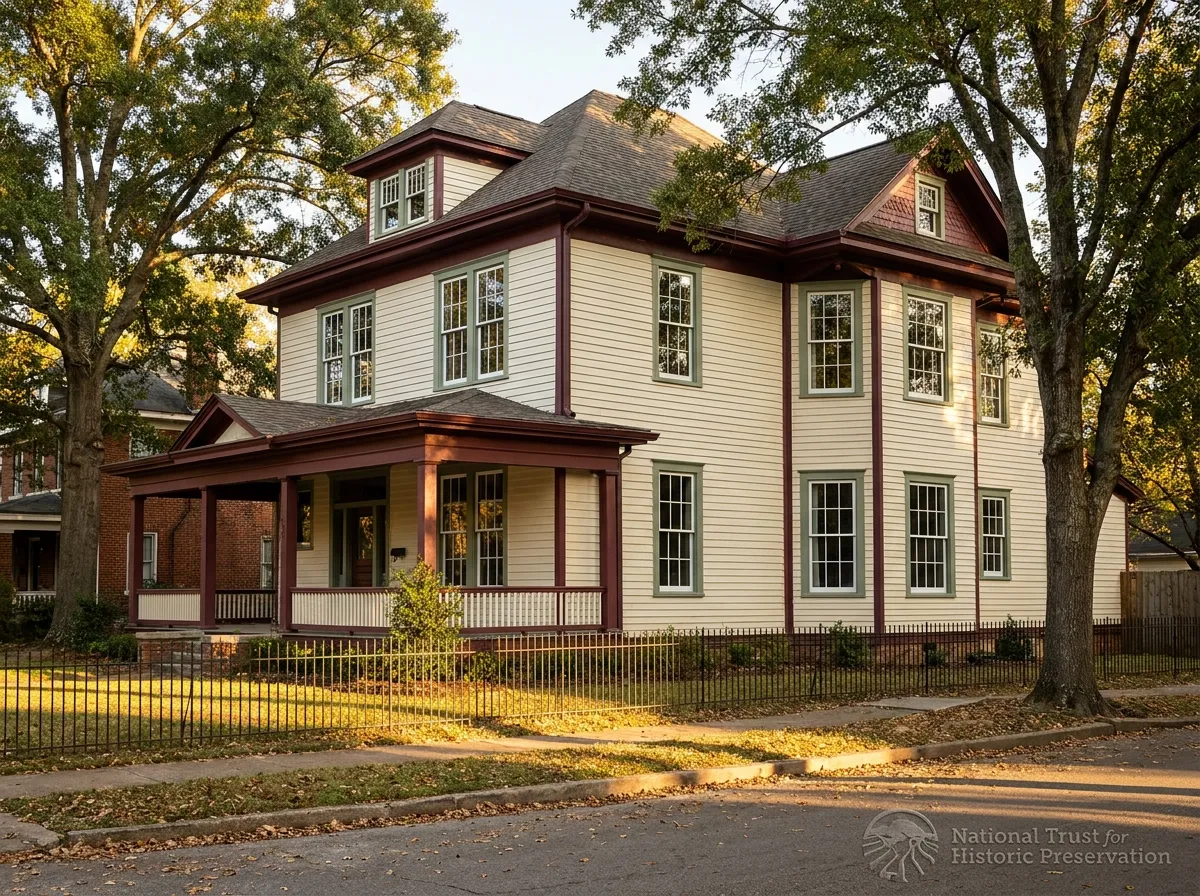
- Sightlines. Old windows tend to have narrow frames and slim meeting rails. A bulky modern frame in the same opening reads wrong from the street. Frame profile is a spec choice, and it should be made deliberately.
- Grille pattern. Six-over-six, nine-over-nine, two-over-two, diamond. Matching the original divided-light pattern does more for the look of the house than almost anything else on the order.
- Exterior trim and brickmold. On many older homes the casing, sill nose and drip cap are part of the character. Full-frame work should reproduce that profile, not replace it with a flat wrap.
- Color. Interior and exterior finishes do not have to match, and on an older home a dark or historically appropriate exterior with a lighter interior is common.
- Glass character. Original wavy glass cannot be reproduced in an insulated unit. If that texture is central to the house, know that going in.
Specifying glass on an old house
Our entire service area sits in the ENERGY STAR South-Central climate zone, where a qualifying window needs a U-factor of 0.28 or lower and an SHGC of 0.23 or lower. In this region, SHGC, the number that describes how much solar heat comes through the glass, does more for summer comfort than pushing U-factor lower.
Old houses often have deep porches on one elevation and full afternoon exposure on another. That is a good argument for spec by elevation rather than one glass package on all four sides. Triple-pane is available on request but is not our default here; in this climate the same money spent on a better low-E coating, argon fill and a warm-edge spacer returns more.
What should you expect the crew to find?
On an older home, some amount of repair scope is normal. The common finds are a soft sill under the old stool, rot at the bottom corners of the jamb where water sat, sheathing damage under a failed drip cap, plaster keys letting go around the interior casing, and framing that was notched or modified during a previous remodel.
What you want is that scope quoted as a visible line item rather than absorbed into a vague total or sprung on you mid-job. Our windows carry a lifetime material and labor warranty under the Patriot's Promise, and dates are committed in a signed timeline agreement, which matters more on an old house because the repair work is real work with real hours in it.
What does it cost, and how do people pay for it?
Replacement windows in our market run $700 to $2,200 per window installed. Older homes skew toward the upper half of that range for three reasons: more full-frame openings, more custom sizes because nothing is standard, and more trim and finish work to keep the exterior looking correct.
A large old house with 20-plus openings is a significant project, and most homeowners phase it or finance it. We offer financing through GreenSky, including no-interest options if paid in full within 6, 15 or 18 months and fixed-rate terms up to 144 months, with zero down for most approved homeowners, subject to credit approval.
Phasing is also perfectly reasonable on an older home. Doing the worst elevation first, usually the one taking weather and afternoon sun, gets the biggest comfort change for the smallest first check.
What is the next step?
On an old house, the estimate is where the real information comes from. The estimator measures each opening individually, looks at what is behind the trim where possible, identifies which openings need full-frame and which do not, and gives one itemized number. It is a sales appointment, and it is also the only honest way to price a house where every opening is its own problem.
Book a free in-home estimate at get an estimate, or call (423) 830-7138. There is no trip charge inside our service area across Tennessee, Georgia and Alabama.