Short answer
For homes in Tennessee, North Georgia and Northeast Alabama, buy a soft-coat Low-E with at least two silver layers, argon fill and a warm-edge spacer, and judge it by the SHGC on the label rather than the coating's trade name. Our region sits in the ENERGY STAR South-Central zone, where a qualifying window needs a U-factor of 0.28 or lower and an SHGC of 0.23 or lower, and the SHGC is the number that controls summer heat. The right answer also changes by elevation, which is why the glass on a west wall should not automatically match the glass on a shaded north wall.
For a home in Tennessee, North Georgia or Northeast Alabama, the coating to buy is a soft-coat Low-E with two or more silver layers, paired with argon fill and a warm-edge spacer. Judge it by the SHGC printed on the NFRC label, not by the coating's marketing name, and accept that the right coating on a west-facing wall is not always the right coating on a shaded north wall.
Low-E is the single most consequential choice inside a replacement window, and it is also the one homeowners get the least information about. Frame material gets discussed at length. Grid patterns get sample boards. The glass gets a sentence. That is backwards, because in a cooling-dominated climate the glass package does more for comfort and operating cost than the frame does.
What does a Low-E coating actually do?
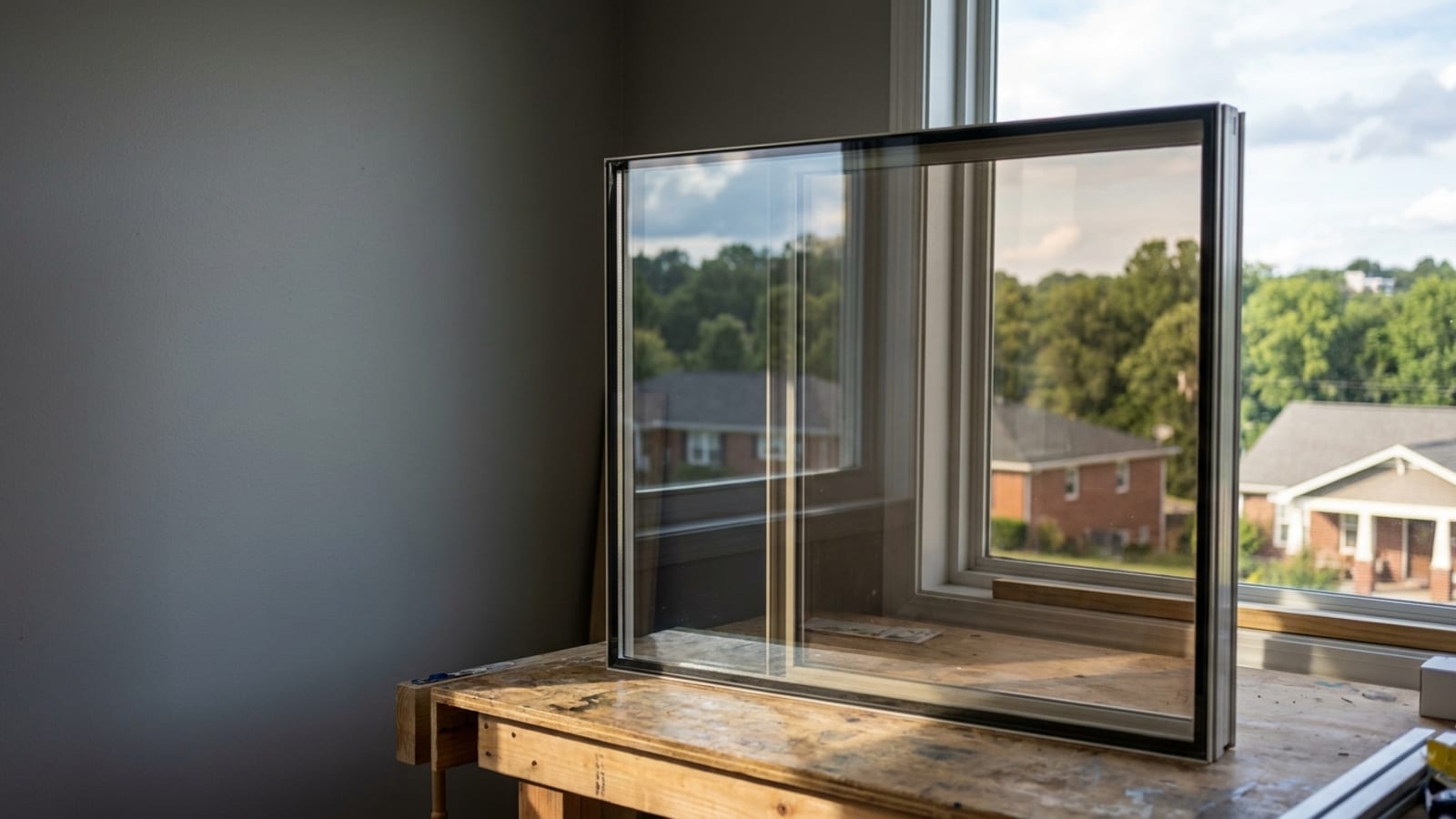
Low-E stands for low emissivity. The coating is a microscopically thin layer of metal oxide — vanishingly thin, measured in nanometers — deposited on one surface of the glass inside the sealed insulated unit. It is invisible to the eye in normal light and you cannot feel it.
What it does is selective. Sunlight arrives as a mix of ultraviolet, visible light and near-infrared energy. A Low-E coating is engineered to let visible light through while reflecting a large share of the infrared — the part you experience as heat radiating off a sunny window. It also reflects long-wave heat back toward whichever side it came from, which is why the same coating helps in winter by keeping room heat from radiating out through the glass.
Uncoated clear double-pane glass has an emissivity around 0.84. A good Low-E coating drops that to roughly 0.04. That is the whole mechanism in one comparison, and it is the reason every window we quote on our replacement window projects carries Low-E, argon-filled insulated glass as a baseline rather than an upgrade line.
Hard-coat or soft-coat — which should you buy?
There are two manufacturing methods, and they produce genuinely different products.
Hard-coat, or pyrolytic, Low-E is applied while the glass is still hot on the float line. The coating fuses into the glass surface and becomes part of it. It is durable enough to be handled, stored and even used as single glazing. It also has a higher emissivity than soft-coat, passes more solar heat, and carries a slight haze or tint that some people notice.
Soft-coat, or sputtered, Low-E is applied in a vacuum chamber after the glass is made. The silver layers it deposits are far more effective at blocking infrared, but they are delicate and oxidize in open air, so soft-coat glass only exists sealed inside an insulated unit with the coating facing the air space.
For replacement windows in this market, soft-coat is the answer. Hard-coat still has legitimate uses — storm windows, some commercial applications, climates where you want solar heat to come in — but in the South-Central zone, where keeping sun out is the job, hard-coat gives up too much.
How many silver layers do you need?
Soft-coat Low-E is categorized by how many layers of silver the coating stack contains. Each additional layer blocks more solar heat and costs a little more visible light.
| Coating type | Typical SHGC | Visible light | Best use in our region |
|---|---|---|---|
| Hard-coat (pyrolytic) | 0.55 – 0.70 | Highest | Storm panels, heating-dominated climates |
| Single-silver soft-coat | 0.35 – 0.50 | Very high | Deeply shaded north openings where you want daylight |
| Double-silver soft-coat | 0.22 – 0.30 | High | The practical default for most Southeast homes |
| Triple-silver soft-coat | 0.18 – 0.25 | Moderate | West and south elevations taking hard afternoon sun |
Those ranges vary by manufacturer and by the full glass build, so always read the label on the actual unit being quoted. The pattern holds regardless: more silver means less heat and slightly less light.
Most homeowners here land on double-silver as the whole-house standard and move to triple-silver where the sun is punishing. Single-silver has a narrow but real place — a north-facing room that already feels dim does not need its daylight cut further.
Which number on the label tells you the coating is right?
SHGC, the Solar Heat Gain Coefficient. It runs from 0 to 1 and measures the fraction of solar energy that gets through the window. Lower blocks more.
Our entire service area sits in the ENERGY STAR South-Central climate zone. Under Version 7.0, effective October 23, 2023, a qualifying window in this zone must hit a U-factor of 0.28 or lower and an SHGC of 0.23 or lower. Both matter, but SHGC is the one that separates a window that works here from a window that works in Minnesota. Cooling load dominates our bills, and SHGC is the only label number that directly addresses it.
U-factor measures heat flow by conduction — it is the winter number, and a window that meets 0.28 is doing its job. Visible transmittance tells you how much daylight you keep. Air leakage measures drafts through the assembly, and lower is better there too.
The mistake we see most often on quotes homeowners bring us is a window chased down to the lowest possible U-factor with an SHGC in the 0.30s. That is a northern specification sold in a southern market. For more on reading the full label, our post on what window energy ratings mean walks through all four numbers.
Should every window in the house get the same coating?
No, and this is where glass selection stops being a catalog decision and starts being a design one.
A west-facing living room window takes three to four hours of direct, low-angle afternoon sun in July. The same house's north-facing bedroom window takes none. Putting identical glass in both means either the west room stays hot or the north room gets needlessly dim.
We spec glass by elevation for exactly this reason. In practice that usually looks like:
- West and southwest openings — the lowest SHGC in the lineup. This is where the summer heat problem lives.
- South openings — a low SHGC, though high summer sun angles and any roof overhang already help here more than people expect.
- East openings — morning sun is real but shorter and less intense; a standard double-silver package handles it.
- North openings — almost no direct gain, so prioritize visible light and let the U-factor do the work.
The frames, color and hardware stay identical across the house. Only the glass inside changes, and nobody standing in the yard can tell.
What else is in the glass package besides the coating?
The coating is the headline, but it works as part of a system.
Argon fill. Argon is denser than air and slows conduction across the gap. It is inexpensive, standard on our units, and pairs with the coating rather than substituting for it.
Warm-edge spacer. The spacer holds the two panes apart at the perimeter. Older aluminum spacers conduct heat straight around the edge of the glass and are a common spot for condensation to show up first. A warm-edge spacer of foam or structural composite cuts that bridge.
Laminated glass. Two panes bonded with an interlayer. This is a noise and safety product rather than an energy one, and it is the upgrade that actually helps on a busy road.
Triple-pane. Available on request, but we do not recommend it as a default here. Triple-pane pays off best in heating-dominated northern climates. In the South-Central zone the payback is slow, and the same money put into a better coating, argon and a warm-edge spacer returns more.
Does a Low-E coating wear out, and is it covered?
The coating itself does not wear out in normal service. It is sealed inside the insulated glass unit, never touched during cleaning, and protected from weather by the glass on either side. What fails, when something fails, is the perimeter seal of the insulated unit — and when that happens you see fog or haze between the panes, the argon is gone, and the unit has to be replaced rather than cleaned.
That is covered. Our windows carry a lifetime material and labor warranty under The Patriot's Promise, transferable one time and prorated after that. When you compare quotes, read the labor term specifically. A lifetime material warranty attached to a one-year labor warranty is a much thinner promise than the headline suggests, because insulated glass service calls involve a crew either way.
What does the glass package add to the price?
Replacement windows in our market run $700 to $2,200 per window installed, and that figure includes the unit, the labor, the sealing and the trim work. The coating choice moves within that range rather than on top of it — stepping from a double-silver to a triple-silver package is a modest per-opening difference, and it is almost always a better use of money than upgrading the frame material on a standard-size opening.
That is the trade we recommend to most homeowners in this climate. Vinyl frames perform well here, and the money saved against fiberglass buys the better glass. For whole-house projects, financing through the GreenSky program includes no-interest-if-paid-in-full plans at 6, 15 or 18 months and fixed rates starting at 6.99% APR, with zero down for most approved homeowners.
One note on budgeting: there is no federal tax credit for windows placed in service in 2026. The Energy Efficient Home Improvement Credit was terminated for property placed in service after December 31, 2025. Plan the project without it.
What to do next
Bring the elevations into the conversation early. When you schedule a free in-home estimate, an estimator measures every opening, notes which direction each one faces, asks how each room behaves in July and in January, and prices the glass package per elevation instead of applying one coating to the whole house. You get one itemized number per opening with the install method and the glass spec written down, so the coating is something you chose rather than something that arrived.