Short answer
Yes. Siding is a shedding surface rather than a sealed skin, so a continuous water-resistive barrier — house wrap — has to go over the sheathing underneath it, lapped and taped so any water that gets behind a panel drains back out. Building codes require a water-resistive barrier behind exterior cladding, and siding manufacturer warranties assume one is installed correctly. Every full siding replacement we do includes the wrap as part of the system.
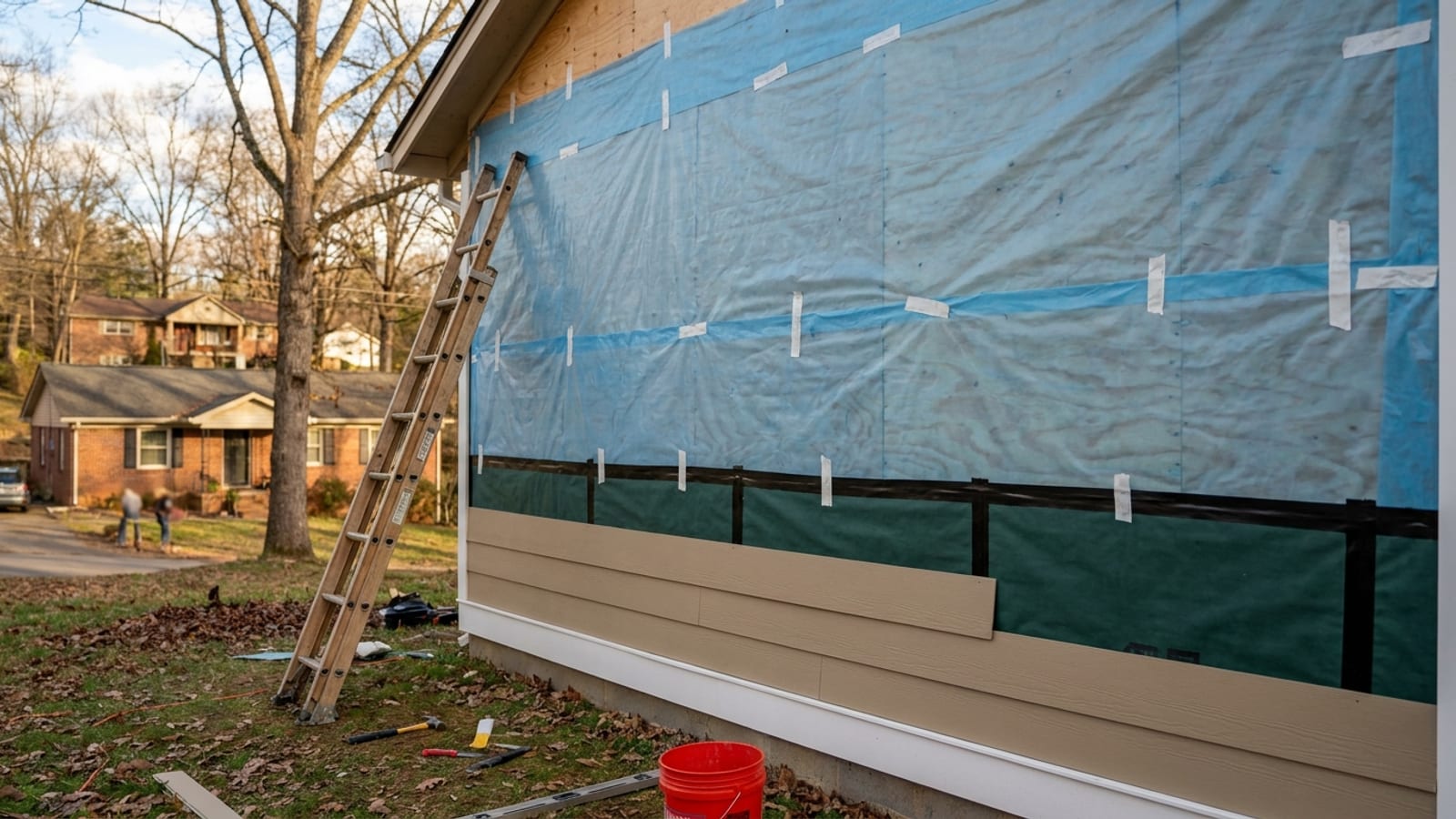
Yes. Siding needs a continuous water-resistive barrier behind it, and on modern jobs that barrier is synthetic house wrap lapped and taped over the wall sheathing. Siding sheds the vast majority of rain, but no cladding on any house is a sealed skin — water finds its way behind panels at butt joints, around penetrations, and in wind-driven rain that pushes up under laps. The wrap is what catches that water, keeps it off the sheathing and framing, and drains it back to the outside.
This is not an upgrade line item. A full siding replacement that leaves out the barrier is an incomplete wall, and most of the expensive siding failures we see on tear-off day trace back to water that got behind the cladding and had nothing underneath to stop it.
What does house wrap actually do?
Three jobs, and they are worth separating because people tend to collapse them into one.
It drains water. Any water that gets past the siding hits the wrap and runs down its face to the bottom of the wall, where it exits at the flashing and the starter course. The sheathing stays dry. This is the primary job and it is the reason the wrap has to be shingle-lapped — upper sheets over lower sheets — so water runs across the seam instead of into it.
It reduces air leakage. A properly taped wrap cuts the air moving through the wall assembly. Air leakage carries both heat and humidity, and in a Southeast summer the humidity is the bigger problem of the two. Reducing it helps the conditioned side of the wall stay comfortable and helps the sheathing stay dry.
It lets the wall dry. Good wrap is permeable to water vapor. That means it blocks liquid water coming in while allowing moisture inside the assembly to pass outward and evaporate. A wall that cannot dry in either direction is the wall that rots.
Siding is a shedding surface, not a seal
This is the single idea that makes the rest of it make sense. Vinyl siding is deliberately hung loose so it can expand and contract, and its butt joints are overlaps, not sealed joints. Fiber cement has tighter joints but still relies on flashing and a barrier behind it. Neither product is marketed by its manufacturer as a waterproof layer. The cladding is the first line; the water-resistive barrier is the one that actually has to hold.
Is house wrap required by code?
In practice, yes. The residential building code adopted across Tennessee, Georgia and Alabama jurisdictions requires a water-resistive barrier behind exterior wall covering, along with flashing at wall openings, at the intersections of walls and roofs, and at the bottom of exterior walls. The specific inspection process varies by city and county, but the requirement itself is not optional in new work or in a full re-side.
When your project requires a permit, we pull it through your local building department as part of full service. The practical effect for you is that an inspector looks at the barrier and the flashing at openings before the siding covers them — a second set of eyes on the layer nobody can see again for thirty years.
What are the options for a water-resistive barrier?
Not all barriers are the same product, and the differences matter more at the seams than in the field of the wall.
| Barrier type | How it works | Strengths | Tradeoffs |
|---|---|---|---|
| Synthetic house wrap (mechanically fastened) | Rolled sheet goods stapled or capped to sheathing, seams taped | Strong, fast to install, drains and breathes, adds air-barrier value when taped | Depends entirely on lap direction and tape quality; fastener holes must be detailed |
| Asphalt-saturated felt | Traditional 15 lb or 30 lb paper, lapped | Drains well, long track record, absorbs and releases some moisture | Tears easily, no real air-barrier function, harder to detail around window flanges |
| Self-adhered membrane | Peel-and-stick sheet bonded to the sheathing | Excellent at openings and transitions, self-seals around fasteners | Highest material cost; usually used at openings rather than whole walls |
| Integrated sheathing with built-in WRB | Barrier bonded to the structural panel at the factory | Very consistent field performance | Only applies when the sheathing itself is being replaced |
On a typical re-side we use a synthetic wrap across the field of the wall with self-adhered flashing at the openings. That combination gets the drainage plane over the whole house and puts the highest-performing material exactly where water concentrates.
Where do house wrap installations actually fail?
The material rarely fails. The details do.
The seams and lap direction
Every horizontal seam has to shingle — upper sheet lapping over lower. Reverse it on one course and you have built a funnel that delivers water to the sheathing instead of past it. Vertical seams get overlapped and taped. A wrap with untaped seams still drains, but it gives up most of its air-barrier benefit.
Window and door openings
This is where almost every wall leak originates. The sill of the opening gets flashed first, the window goes in, the jambs get flashed over the window flange, and the head flashing laps over everything and under the wrap above. Get that sequence out of order and water runs behind the flashing instead of over it. If we are doing siding and windows on the same project, we sequence them so these layers go on in the right order the first time rather than being patched together afterward.
Penetrations
Hose bibs, dryer vents, electrical boxes, light fixtures, satellite mounts and every old fastener hole from the previous siding are all places water can get to the sheathing. Each one needs a block, a flashed box, or sealant appropriate to the material — not a bead of caulk smeared over a torn edge.
The bottom of the wall
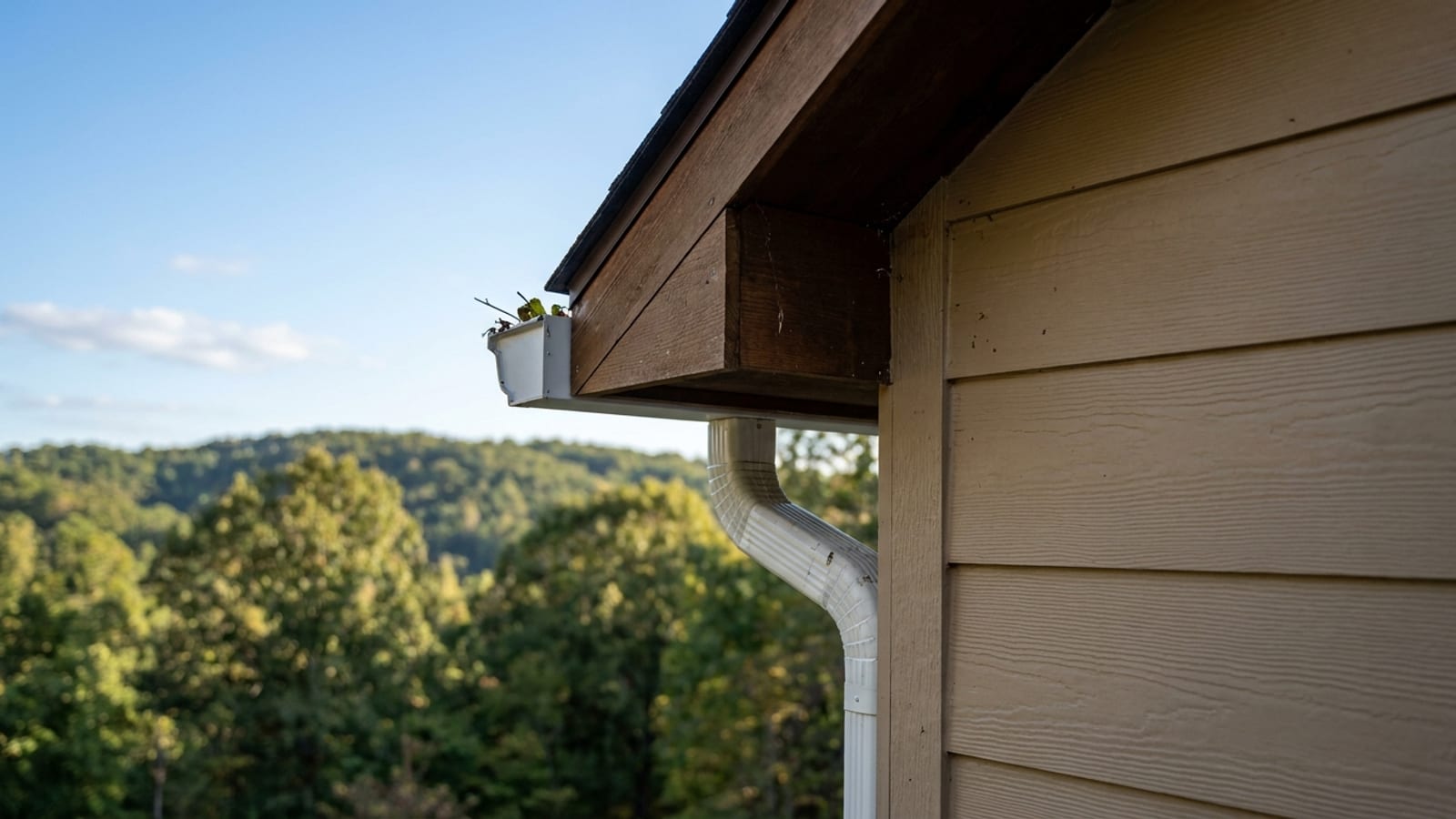
Water running down the wrap has to exit. Flashing at the base of the wall and a correctly set starter course give it somewhere to go. If the wrap is tucked behind a trim board with no exit path, the water pools at the bottom of the wall, which is where soft sheathing and rotted bottom plates get discovered years later.
Does the barrier matter for vinyl as much as for fiber cement?
Yes, and arguably more. Vinyl's loose-hung joints mean more water gets behind it in a driving rain than behind a tightly fitted fiber cement wall. The barrier is doing more work on a vinyl job, not less. Whether you are installing James Hardie fiber cement, Everlast composite, Royal or Mastic vinyl, or a mix with stone veneer, the layer underneath is the same requirement.
For manufacturer warranty purposes, this matters. James Hardie's installation requirements assume a code-compliant water-resistive barrier and correct flashing. We hold James Hardie Alliance Select certification, which means the install is done to that spec — and the product warranty behind it stays intact. Our own Patriot's Promise covers the workmanship side, including the layers you cannot see once the siding is on.
Should there be a drainage gap behind the siding?
A rainscreen — a deliberate air gap between the wrap and the back of the cladding, created with furring strips or a drainage mat — gives water an even clearer exit and lets the back face of the siding dry. It is not required on every wall in this climate, but it earns its cost on elevations that take driving rain, on walls that stay shaded and damp most of the year, and on tall two-story elevations with a lot of wall area above grade.
It adds material and labor, so it belongs in the conversation at the estimate rather than as a surprise on the invoice. We will tell you which of your elevations are candidates and which are not.
What does the barrier add to the cost of a siding job?
It is not a separate line you shop. A full siding replacement in our market typically runs $12,000 to $25,000 installed, and that number already includes trim, soffit, fascia and house wrap, because none of those are optional parts of a finished wall. What moves your number is square footage, how many stories, how much trim detail the elevations carry, and what the sheathing looks like once the old siding is off.
That last item is the one nobody can price from the curb. Sheathing repair found on tear-off day is real work and it is the reason we quote from an in-home walk rather than from satellite images. If spreading the project makes sense for your budget, financing through the GreenSky program is available with terms from no-interest promotional plans to fixed-rate options.
What should you ask when you compare two siding quotes?
Four questions get you most of the way to an honest comparison:
- Is the existing siding being removed down to the sheathing, or is new material going over the old?
- What water-resistive barrier is specified, and are the seams taped?
- How are the window and door openings being flashed, and in what sequence?
- Does the price include trim, soffit, fascia and the barrier, or are those adds?
If one quote is noticeably lower, one of those four answers is usually why. A thinner scope under the siding is invisible on the day the job finishes and expensive five years later.
What is the next step?
If you are planning a re-side, have someone look at the walls before you pick a color. Book a free in-home estimate at /get-estimate/ and we will walk the elevations with you, look at the condition of the existing cladding and trim, explain exactly how the barrier and flashing will be detailed on your house, and give you one itemized number. It is a sales appointment, and it is also the only way to get a real figure instead of a guess.