Short answer
A full vinyl siding replacement in Georgia typically runs $12,000 to $25,000 installed, and that number covers trim, soffit, fascia and house wrap, not just the panels. Where your house lands inside that range depends on wall area, how many stories, how much trim detail the elevations carry, and what the sheathing looks like once the old cladding comes off. The itemized figure comes from a free in-home estimate, because no two walls are found in the same condition.
A full vinyl siding replacement in Georgia typically runs $12,000 to $25,000 installed. That figure is not panels alone — it covers the trim, soffit, fascia and house wrap, the labor, the tear-off and the cleanup, which is the only version of the number worth comparing against another quote.
The spread between those two ends is wide for a reason. A one-story ranch in Dallas with simple gables and a modest wall area is a different job than a two-story house in Roswell with dormers, box bays, shutters and three hundred feet of trim to wrap. Both are legitimate vinyl jobs. They do not cost the same, and no honest number exists until somebody measures your walls.
What does a vinyl siding price in Georgia actually include?
When we quote siding replacement, the price is for the full envelope, because that is the only way the system works as a system. A complete job includes:
- Full tear-off of the existing cladding down to the sheathing
- Inspection of the sheathing and repair of any rot or water damage found
- House wrap installed as a continuous weather-resistive barrier
- New vinyl panels installed to manufacturer spec, with correct fastening and clearances
- New trim, corner posts, J-channel and window and door surrounds
- Soffit and fascia
- Caulking, flashing details and final sealing
- Haul-off and a magnet sweep of the yard
We do not side over existing siding and we do not patch a failing system. That is a scope decision, not an upsell one — anything hiding behind the old panels stays hidden if nobody takes them off.
What decides where your house lands in the range?
Five things move a Georgia siding number more than anything else.
Wall area, not house square footage
Homeowners think in floor square footage. Siding is priced on wall area, and the two do not track. A 1,900 square foot two-story with a compact footprint has less wall to cover than a sprawling 1,900 square foot ranch. Gable ends, walkout basements and bonus rooms over garages all add wall that never shows up in the listing square footage.
Number of stories and access
A second story means staging, ladders and slower work per panel. A steep lot, a screened porch in the way, or mature landscaping tight to the foundation all slow the crew down in the same way. None of that is dramatic on its own, and all of it adds up across four to seven days.
How much trim detail the elevations carry
Trim is where the hours go. Every window and door gets wrapped. Every corner gets a post. Dormers, bay projections, gable vents, multiple rooflines and decorative brackets each add linear feet of cut-and-fit work. Two houses with identical wall area can differ by thousands of dollars purely on how many edges there are.
What the sheathing looks like underneath
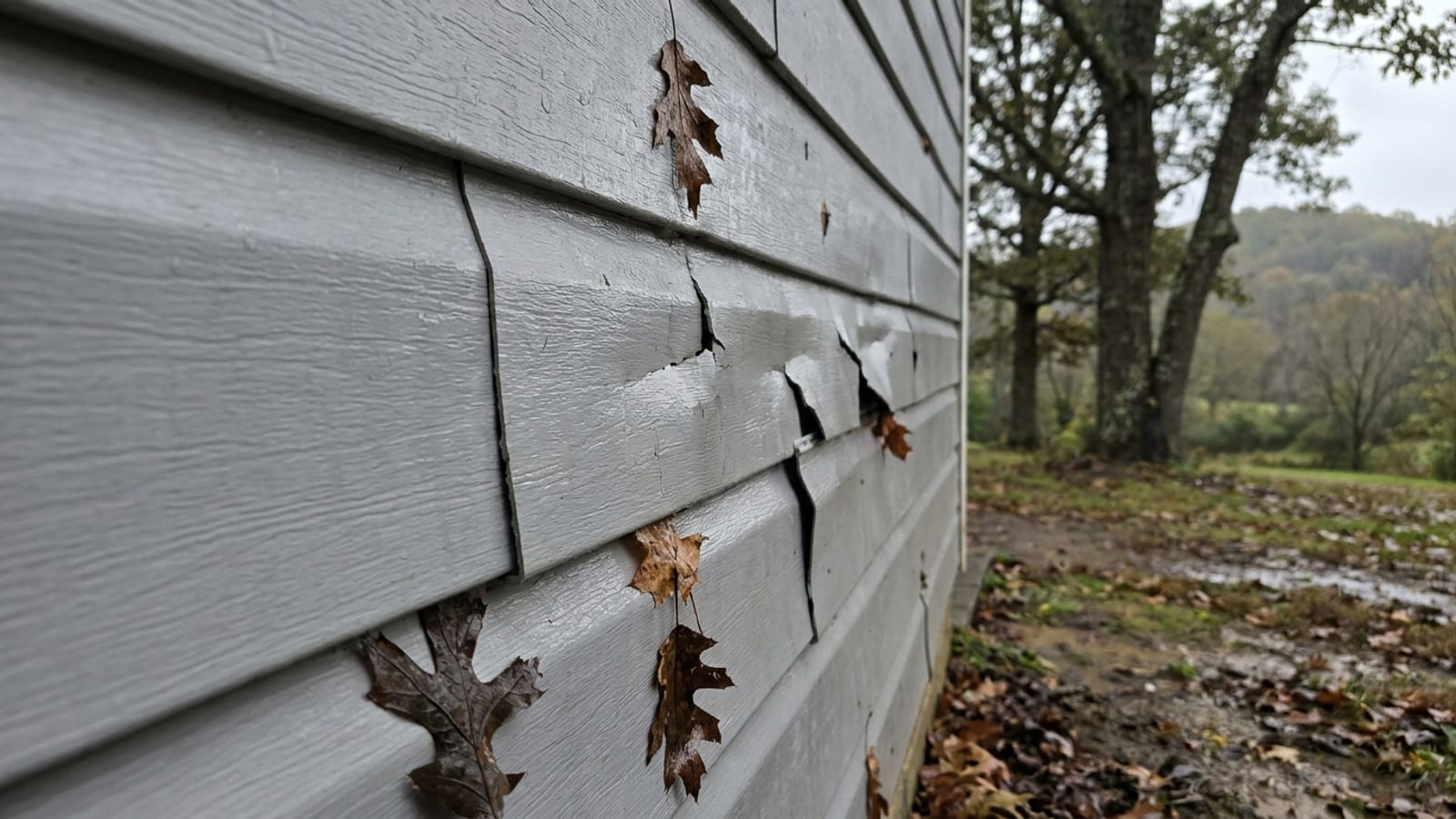
This is the one nobody can price from the driveway. Georgia gets heavy rain, and long-term water entry around windows, at roof-to-wall intersections and behind failing caulk shows up as soft sheathing. Sound sheathing means the new system goes straight on. Rot means repair first. A good estimator tells you at the estimate how that will be handled and priced if it is found, rather than leaving it as a surprise.
Which vinyl you choose
Vinyl is not one product. Panel thickness, profile, texture, color depth and insulated backing all shift the price. We install Royal and Mastic vinyl as well as Everlast composite, and the honest guidance is that the jump from builder-grade to a quality panel is money well spent — the thicker panel lies flatter on the wall and holds its appearance longer.
| Factor | Pushes toward the lower end | Pushes toward the upper end |
|---|---|---|
| Stories | Single story | Two or three stories |
| Wall shape | Simple rectangles and gables | Dormers, bays, multiple rooflines |
| Trim | Few openings, plain surrounds | Many windows, wide decorative trim |
| Sheathing condition | Sound and dry | Rot repair and sheathing replacement |
| Product | Standard-profile vinyl | Heavier panel, insulated backing, deep color |
| Access | Open yard, easy staging | Steep lot, tight setbacks, landscaping |
How does vinyl compare with fiber cement on cost?
This is the real budget question for most Georgia homeowners, especially across the metro Atlanta corridor where both products are common on the same street. Vinyl is roughly 40 to 70 percent cheaper installed than fiber cement. That is a meaningful difference on a whole house.
| Vinyl | James Hardie fiber cement | |
|---|---|---|
| Installed cost | Lowest of the two | Higher, often substantially |
| Typical lifespan | 20–40 years | 30–50 years |
| Maintenance | Wash once a year | Wash; ColorPlus finish holds color |
| Impact and fire | Can crack in hard impact | Fire-resistant, will not melt |
| Best fit | Value, shorter ownership horizon | 10-plus years, architectural detail |
The deciding question is how long you are staying. Under five years, vinyl is the sensible answer. Ten-plus years or a forever home, fiber cement usually wins on total cost of ownership. Mixing the two — fiber cement on the street-facing elevation, vinyl on the sides and back — is a legitimate compromise that we price regularly, and it is worth asking about if the front of the house carries all the detail anyway.
Does location inside Georgia change the price?
Less than people expect. The installed range holds from Dalton and Ringgold down through Cartersville, Marietta and the metro Atlanta suburbs. What changes by area is the housing stock, and housing stock is what drives cost.
North Georgia has more older homes with original wood siding, which means more chance of finding rot at the bottom courses and around windows. The 1980s and 1990s subdivision stock across Cobb, Cherokee, Paulding and Gwinnett tends to be two-story with a lot of openings and a lot of trim, which pushes those houses up the range even when the sheathing is clean. Neither is a regional price premium. It is the same work priced against a different wall.
What should you check before you compare two siding quotes?
Compare line by line, not by the number at the bottom. The items that most often explain a lower price:
- Is the old siding coming off, or is the quote for siding over it?
- Is house wrap included and named as a product?
- Are soffit, fascia and all trim in the price, or listed as extras?
- What panel and profile — brand and series, not just "vinyl"?
- How is rot handled if it is found, and at what rate?
- What is the warranty term on labor, not just on material?
That last one separates quotes more than anything else. A long material warranty paired with a one-year labor warranty is a much weaker promise than it sounds. Our siding carries a 30-year material and labor warranty under The Patriot's Promise, with $2 million in liability insurance on every job and a signed timeline agreement on the dates.
How do homeowners pay for a siding project?
Most people pay cash, use contractor-arranged financing, or draw on home equity. Siding is harder to phase than windows because the whole envelope comes off and goes back on as one system, so the question is usually how to spread one number rather than how to split the work.
We offer financing through the GreenSky program: no interest if paid in full within 6, 15 or 18 months, or fixed rates starting at 6.99% APR with terms out to 144 months. Zero down for most approved homeowners, subject to credit approval. One planning note that matters this year — there is no federal tax credit for siding work placed in service in 2026, so budget without one.
How long will the crew be at the house?
Most siding installations run 4 to 7 days depending on size and detail. The house stays livable the entire time. Crews work elevation by elevation and never leave a wall open overnight, and the dates are committed in writing before the first panel comes off.
What is the next step?
Nobody can give you a real vinyl siding number from a satellite photo. The wall area, the trim count and the condition of what is behind the old panels decide the price, and those take a walk-around and a tape measure. Book a free in-home estimate at /get-estimate/ and you will get one itemized figure with the scope spelled out — what comes off, what goes on, what happens if we find rot, and what the warranty covers.