Short answer
Double-hung is the better buy for most homes here, because both sashes operate and both tilt inward for cleaning, which matters most on a second story. Single-hung costs less per opening and has fewer moving parts, which makes it a reasonable choice on a ground-floor opening you can reach from outside or on a window you almost never open. The price gap within the same product line is usually small, so the decision comes down to the floor the window sits on and how you plan to clean it.
Double-hung is the right buy for most homes in this market, and the reason is cleaning, not performance. Both sashes operate and both tilt into the room, so you wash the outside of a second-story window standing on your bedroom floor. Single-hung is the value version of the same window — the bottom sash slides, the top sash is fixed in place — and it earns a spot on ground-floor openings and on windows that almost never get opened.
That is the whole decision in two sentences. What follows is the detail that makes it a real choice rather than a guess, because the two styles sit side by side in every replacement window catalog, look nearly identical from the curb, and get sold interchangeably by people who never explain the difference.
What is the actual difference between the two?
Both are vertical-sliding windows. Both have two sashes stacked in the frame, both use an exterior screen over the lower half, and both suit almost every house style in Tennessee, North Georgia and Northeast Alabama. The difference is which sashes move.
Single-hung
The lower sash slides up and down on balances. The upper sash is fixed in the frame and does not move at all. You get ventilation at the bottom of the opening only, and exterior glass on the top half has to be cleaned from outside.
Double-hung
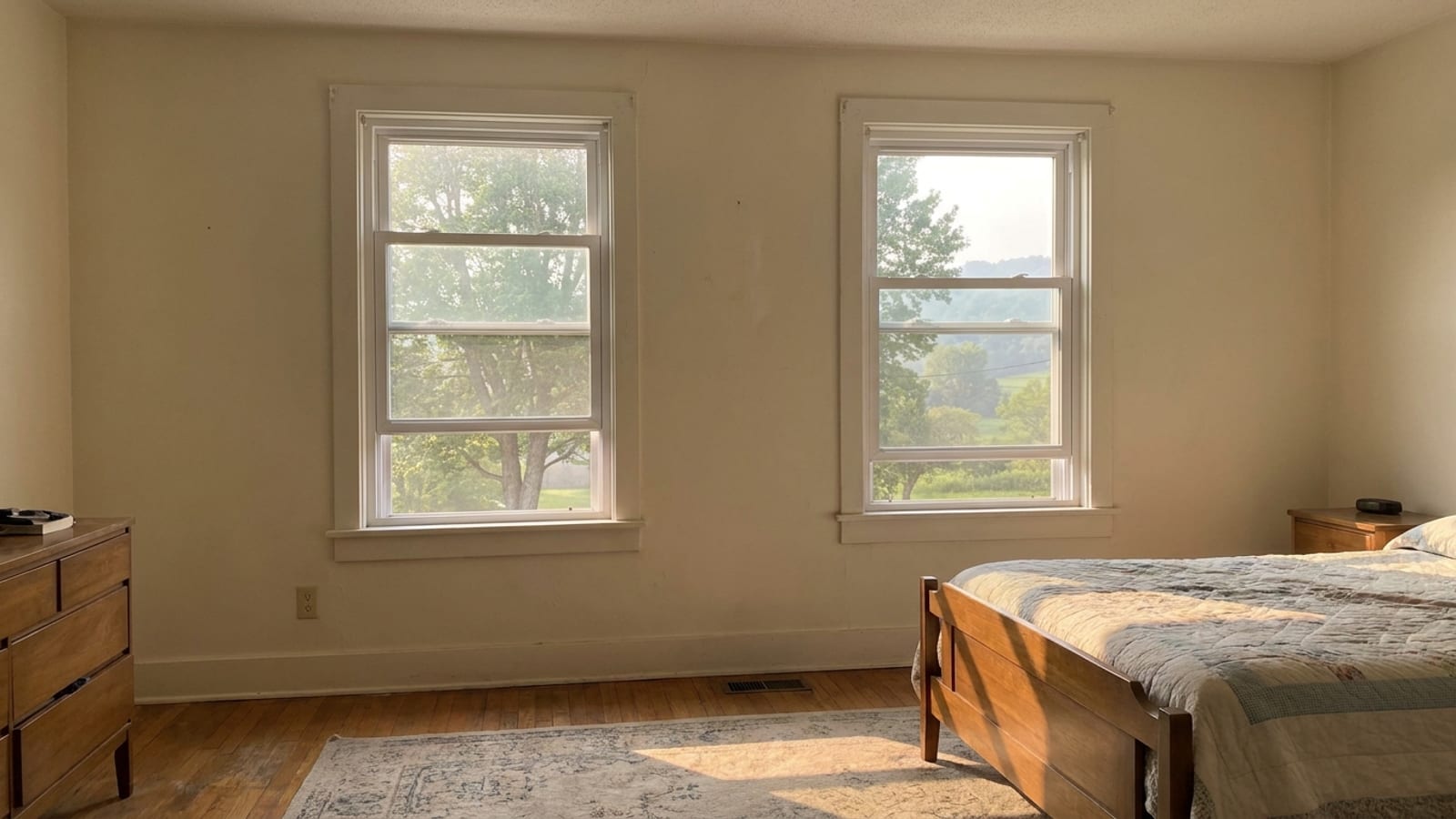
Both sashes operate. You can raise the bottom, lower the top, or split the opening and do both at once. On the lines we install, both sashes also tilt inward at the latches so the exterior face of the glass swings into the room.
That tilt function is the feature homeowners actually use. Everything else about the comparison is secondary to it.
How do single-hung and double-hung compare on paper?
| Single-hung | Double-hung | |
|---|---|---|
| Operating sashes | Lower only | Both |
| Upper sash | Fixed | Operates and tilts |
| Tilt-in cleaning | Lower sash only | Both sashes |
| Ventilation | Bottom of opening | Top, bottom or both |
| Balance hardware | One set | Two sets |
| Screen location | Exterior, lower half | Exterior, lower half |
| Best fit | Ground floor, rarely opened | Whole house, upper floors |
| Cost within the installed range | Lower end | Slightly higher |
Windows in our market run $700 to $2,200 per window installed, and that figure covers the unit, the labor, the sealing, the trim and the cleanup. Within one product line, the step from single-hung to double-hung is a smaller line item than the step from an insert to a full-frame replacement, or the step from a standard glass package to an upgraded one. Put differently: if the budget is tight, there are two other decisions on the quote that move the number more than this one does.
Which one is easier to clean?
Double-hung, and it is not close on anything above the first floor.
With a double-hung, you release both tilt latches, pivot each sash into the room, and wash all four glass surfaces at arm's length. No ladder, no leaning out, no hiring anyone. With a single-hung, the lower sash tilts, and the upper sash does not — so the top half of the glass is cleaned from the outside, which on a second-story bedroom means an extension ladder or a long pole and a lot of water running down the siding.
If your house is one story with easy ground around it, this matters much less. If you are standing in a two-story foyer looking up at a transom-height sash, this is the entire argument.
Does one style ventilate better?
Double-hung has a real advantage here that most homeowners never use and then wish they had known about.
Opening only the bottom sash pulls cool air in low. Opening only the top sash lets the hottest air in the room, which collects at the ceiling, spill out. Opening both halfway sets up a loop — in at the bottom, out at the top — in a single window. In a Tennessee Valley spring or fall, when the air conditioning is off and the windows are open, that upper sash does noticeable work in bedrooms and upstairs hallways.
There is a second, quieter benefit. Lowering the top sash a few inches ventilates a room with small children or pets in it without leaving a reachable opening at floor level.
Does a fixed upper sash seal better or last longer?
This is the most common argument made for single-hung, and it is weaker than it sounds.
It is true that a fixed sash has no balances and no tilt hardware, which is less to wear out over decades. It is also true that modern double-hung units are built and tested as complete assemblies, and the number that tells you how much air moves through a closed window is the air leakage rating on the NFRC label — not the count of moving parts. A good double-hung and a good single-hung from the same series test very close together.
What actually determines whether a window is drafty in year three is the installation: how the unit was shimmed, how the perimeter was insulated and air-sealed, and how the exterior was flashed and finished. That is why both styles come with the same coverage under The Patriot's Promise — lifetime material and labor, transferable once and prorated after that. A warranty that names a labor term is the one that covers the part of the job most service calls turn out to involve.
What should the glass package be, either way?
The same, and it should be chosen by elevation rather than by style.
Our entire service area sits in the ENERGY STAR South-Central climate zone, where a qualifying window needs a U-factor of 0.28 or lower and an SHGC of 0.23 or lower. In this region SHGC is the number to watch, because cooling load dominates — the job of the glass here is keeping summer sun out, not holding furnace heat in. On west- and south-facing walls, a lower SHGC does more for comfort than chasing a slightly better U-factor.
Triple-pane is available on request but is not our default in this climate. The returns are strongest in heating-dominated northern climates; here, the same money spent on a better low-E coating, argon fill and a warm-edge spacer returns more.
Where does single-hung still make sense?
Four situations, and they are legitimate:
- Ground-floor openings with easy access outside. If you can walk up to the glass with a bucket, the tilt-in upper sash is a convenience you will not miss.
- Windows that are never opened. A hallway window behind a console table, a window over a stair landing, a unit tucked behind a shrub bed — none of these need two operating sashes.
- High opening counts on a fixed budget. On a house with twenty-plus openings, choosing single-hung on the back and sides while keeping double-hung upstairs is a sensible way to keep the whole house on one project instead of splitting it across two years.
- Matching an existing run. If half the house was already replaced with single-hung and the sightlines need to agree, consistency wins.
A mixed house is normal. From the street, with the same frame color and the same grid pattern, nobody can tell which units have an operating top sash.
How does this affect egress?
It affects the math. Bedroom egress is measured on the clear opening you actually get, and on both of these styles that is the lower sash raised — the fixed or closed upper sash is not part of it. A single-hung and a double-hung of identical size produce a similar clear opening, so the style is rarely the deciding factor. The size of the opening is.
Where it matters is on older houses with short, wide windows in bedrooms, where neither style may make egress without enlarging the rough opening. Permitted work puts an inspector on egress sizing and safety glass locations, and we pull the permit through your local building department as part of full service when your project requires one.
What to check before you sign
When you are comparing two quotes, make sure the style is actually spelled out per opening. "Hung windows" on a line item is not a specification. The quote should name the product series, the style per opening, the glass package including SHGC, whether the work is insert or full-frame, and the labor term on the warranty.
If cost is what is driving the single-hung question in the first place, run the numbers both ways before you decide. We offer financing through the GreenSky program, including no-interest-if-paid-in-full plans at 6, 15 or 18 months and fixed rates starting at 6.99% APR, with zero down for most approved homeowners. For some houses that turns the style question back into a straightforward one.
The next step
Walk your house and sort the openings into two piles: the ones you will physically clean from outside without complaint, and the ones you will not. The second pile should be double-hung. Then request a free in-home estimate. An estimator measures every opening, checks the frames and sills, shows you both styles in the actual product, and gives you one itemized price per opening with the install method written down. It is a sales appointment, and it is also the only way to get a real number instead of a guess.