Short answer
Replace the threshold or sill when the wood beneath it is soft, when the sill plate or subsill has water damage, or when the threshold is corroded, cracked or no longer sits tight against the door bottom. If the frame and subsill are sound and the only problem is a gap you can feel, an adjustable threshold can often be raised or a new sweep and weatherstrip installed instead. The deciding factor is whether the damage is in the part or in the structure under it.
Replace the threshold or sill when the wood under it has gone soft, when you can see daylight at the bottom corners with the door closed and locked, or when water is reaching the floor inside during a storm. Short of that, a door that drags slightly, a draft you can feel at your ankles, or a flattened sweep is usually an adjustment or a replacement part rather than a new door.
The threshold is the piece of an entry door system that takes the most abuse and gets the least attention. It is walked on every day, rained on, baked by afternoon sun, and asked to hold a weather seal against a moving panel. It is also the first place a door system shows you that water has been getting in for a while.
What is the difference between a threshold and a sill?
Homeowners use the two words interchangeably, and on a door quote they mean different parts.
The sill is the structural bottom of the door frame. On a prehung unit it is the composite or wood member that spans the opening between the two jamb legs, sloped to shed water outward. It is part of the frame and it is not meant to be removed on its own.
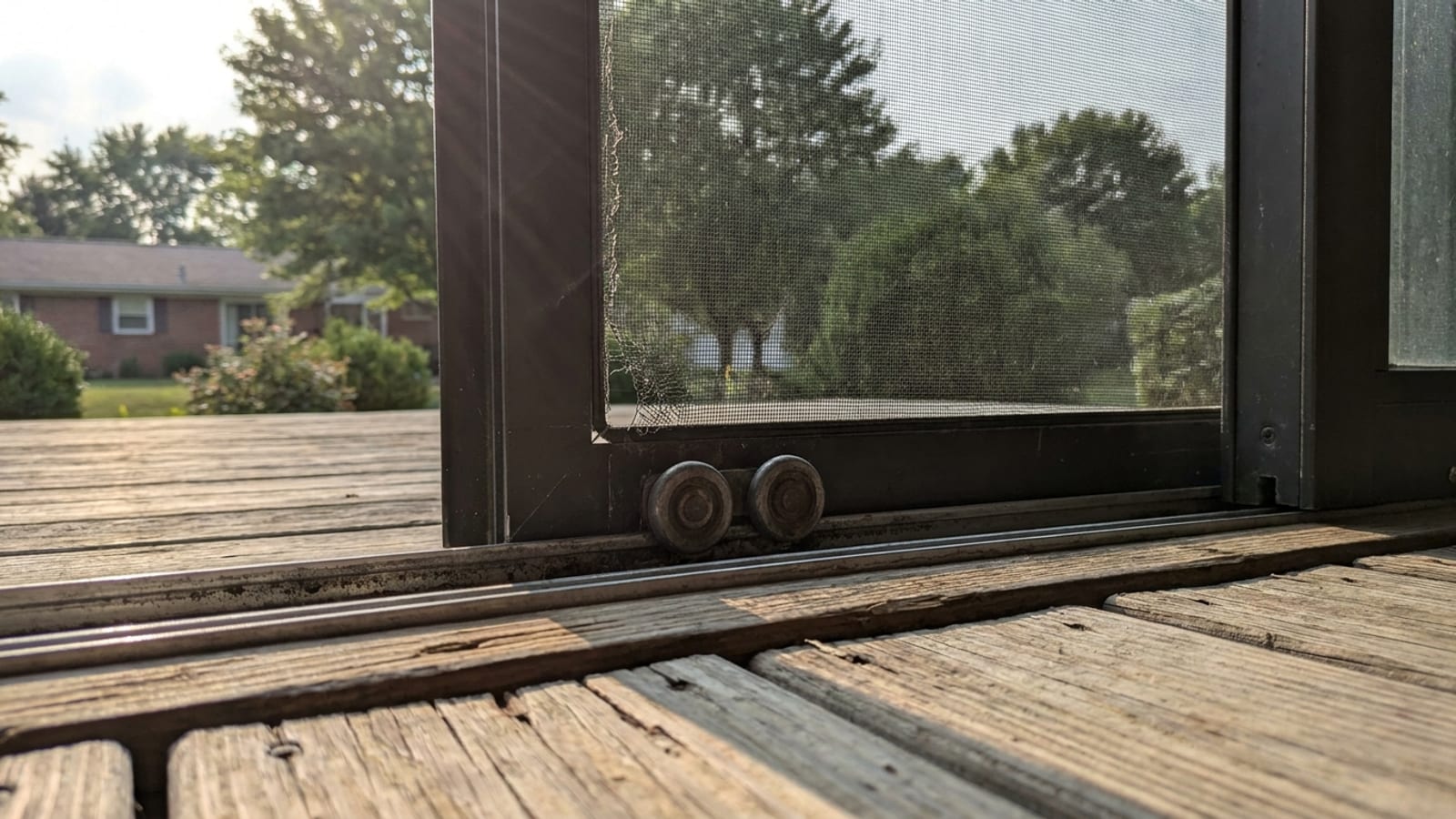
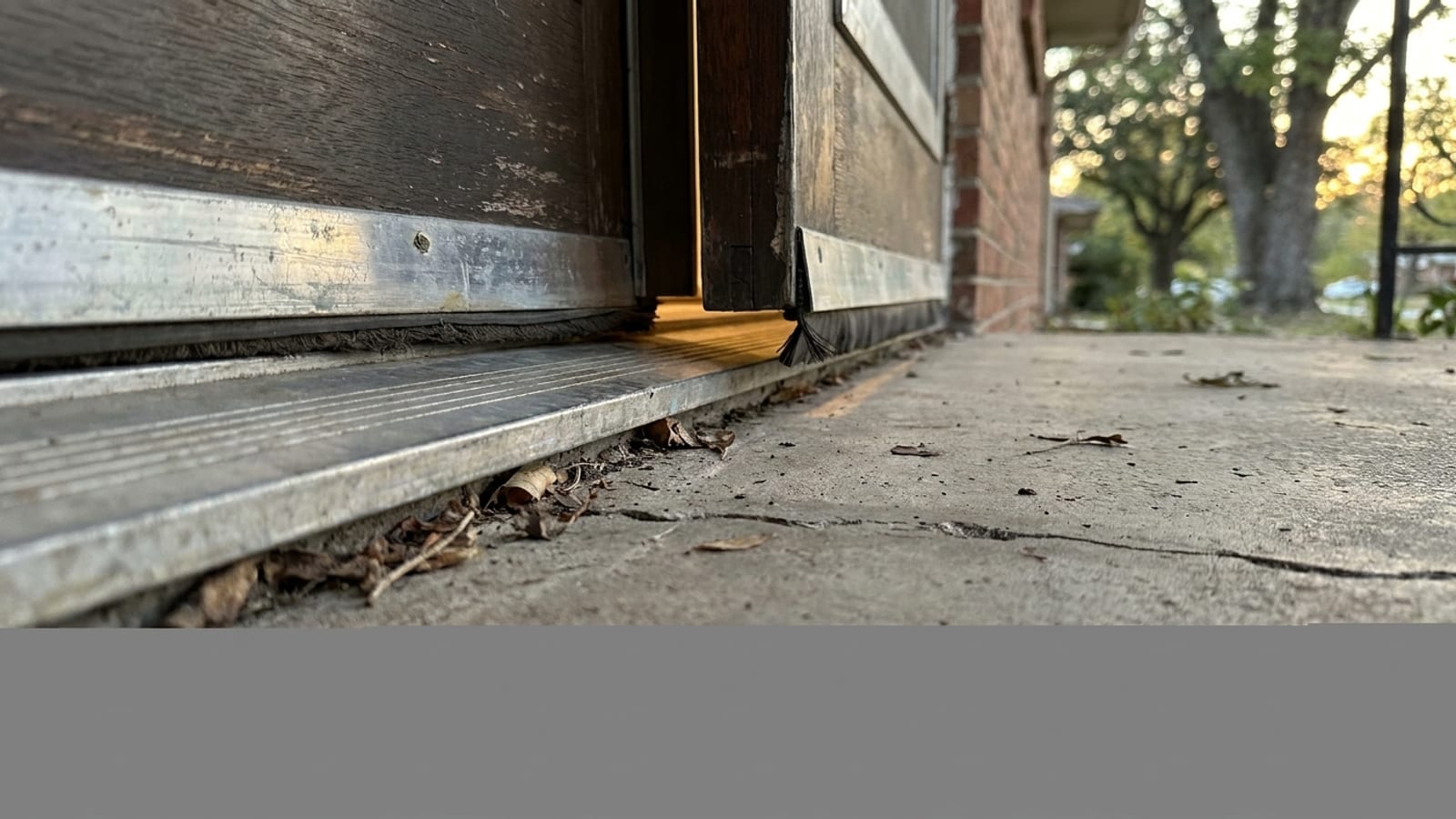
The threshold is the capped top surface you step over, commonly aluminum over a wood or composite core, often with a vinyl or rubber insert that the door sweep presses against. Many modern thresholds are adjustable, meaning a row of screws under the cap lets the installer raise or lower the surface to meet the sweep.
Under both of them sits the subsill, the framing and sheathing at the bottom of the rough opening. That is the part nobody sees, and it is the part that decides whether this is a small job or a real one.
How do I know the threshold or sill actually needs replacing?
Five signs matter more than the rest.
Soft wood when you press on it
Push a screwdriver, firmly but not violently, into the wood at the outer edge of the sill and into the floor just inside the door. If the tip sinks, the moisture has been there long enough to break down the fibers. Soft wood under a threshold is not a part problem, it is a water path problem, and new material set on top of it fails the same way.
Daylight at the corners
Close and lock the door, turn the lights off inside and look at the bottom corners. A thin line of light across the middle usually means the threshold needs raising or the sweep is worn. Light at the corners, where the sill meets the jamb legs, points at a sill that has settled, a frame that has racked, or a corner seal that has failed.
Water on the floor inside
A dark line across the interior flooring, lifted laminate edges, or a damp mat after every hard rain all say water is getting past the sill rather than over it. In this climate the usual culprits are a missing sill pan, an unsealed joint where the threshold butts the jamb, or a porch slab that slopes back toward the house.
Corrosion, cracking or a loose cap
Aluminum caps pit and corrode where salt, fertilizer and standing water sit on them. Composite caps crack under thermal cycling. A cap that lifts or rocks underfoot has lost its fasteners into a core that is no longer holding a screw.
The adjustment has run out
An adjustable threshold has a travel range. If the screws are already at the top of their range and you still have a gap, there is nothing left to take up, and the seal has to come from a new threshold or a new unit.
What are the repair and replacement options, and what do they involve?
| What is wrong | The usual fix | Scope |
|---|---|---|
| Gap you can feel, frame sound | Raise the adjustable threshold | Minutes, no parts |
| Worn or flattened door sweep | New sweep or bottom seal | One visit, small part |
| Failed corner seal or jamb joint | Clean and reseal the joint | One visit |
| Corroded or cracked threshold cap, sound subsill | Replace the threshold | Half a day, frame disturbed |
| Rotted sill, sound framing | New door unit with repaired subsill | Part of a door replacement |
| Rotted subsill or floor framing | Structural repair, then new door unit | Adds time to a door install |
The honest line between the top half and the bottom half of that table is moisture. Anything above the fold is a part or an adjustment. Anything below it means water has been entering the assembly, and the correct sequence is to find the water path, repair the structure, then set a new unit on a properly flashed sill pan.
Why do thresholds fail faster in Tennessee, Georgia and Alabama?
Three local conditions do most of the damage.
Driving rain on an unprotected entry. Many houses here have shallow stoops rather than deep porches. A west- or south-facing door with two feet of overhang takes the full load of a summer thunderstorm straight onto the threshold.
Humidity plus heat cycling. The cap gets hot enough in afternoon sun to expand noticeably, then cools overnight. Repeat that several hundred times a year and fasteners loosen, sealant joints open, and a wood core that has absorbed any moisture starts to break down from the inside.
Slabs that settled the wrong way. Concrete porches and walkways in this region move with the clay underneath. A slab that once sloped away from the house can end up sloping back, which turns the threshold into a dam instead of a drain.
That is why exposure, not age, is usually the better predictor. Two identical doors installed the same week can be in completely different condition if one of them sits under a covered porch and the other faces an open stoop on the west side.
What does this work cost?
A sweep, a seal or a threshold adjustment is a small service item. A threshold replacement is more involved than it looks because the part is tied into the frame on most prehung units, and once the frame is disturbed, the sensible comparison becomes the cost of a complete door unit that carries its own factory sill, weatherstrip and warranty.
A replacement entry door installed runs about $3,973 to $7,500 in our market. That is a complete number covering the door, the frame, the hardware, the labor and the finish work. The range moves on material, glass, sidelites or a transom, and on what the opening looks like once the old unit is out. Subsill repair found behind a rotted threshold is the single most common reason a door quote lands higher than a homeowner expected, which is why that possibility gets discussed at the estimate rather than discovered on install day.
If the number is the obstacle, the financing options include no-interest-if-paid-in-full plans at 6, 15 or 18 months and fixed-rate terms through the GreenSky program, with zero down for most approved homeowners. Active military, veterans, police, fire, EMS and dispatchers get 50 percent off exterior doors under the Hometown Hero program, which is standing rather than seasonal.
What does a correct sill and threshold installation include?
When a new door goes in, the parts you never see are the ones that decide how long the threshold lasts.
- The old unit and frame come out and the subsill is inspected rather than assumed.
- Any damaged framing or sheathing is repaired before anything new is set.
- A sill pan or pan flashing goes under the new sill so water that gets in has somewhere to drain back out.
- The unit is set plumb, level and square, shimmed at the hinges and the strike.
- The perimeter is insulated and air-sealed, and the exterior joints are sealed in the right order so laps shed water downward.
- The threshold is adjusted to the sweep, the door is cycled and checked for even contact, and the hardware is set.
Workmanship at the sill is exactly the kind of detail a warranty should cover in writing rather than by reputation. The Patriot's Promise names the terms on material and labor so you know what is standing behind the install years from now, not just on the day the crew drives away.
What should I do next?
Start with the simple checks. Lock the door, look for light, press for soft wood, and try the threshold adjustment screws. If those three take care of it, you have spent an afternoon and a few dollars. If the wood gives, the light shows at the corners, or water keeps appearing inside after a storm, the problem is in the structure under the door and it is worth having someone look at the opening.
Schedule a free in-home estimate. An estimator measures the opening, checks the sill and subsill condition, explains whether this is a part, a threshold or a full unit, and gives you one itemized price. It is a sales appointment, and it is also the only way to know what is under that threshold before the work starts.